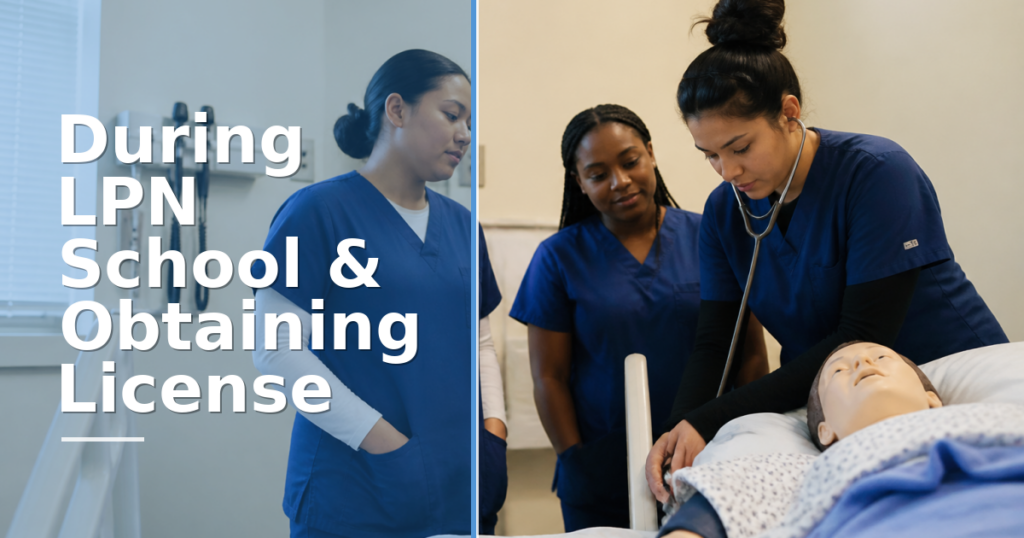
No state board of nursing will approve an LPN candidate for the NCLEX-PN without documented supervised clinical hours. That single requirement is why every "online LPN program" is actually a hybrid: didactic courses in pharmacology, anatomy, and nursing fundamentals move online, while skills labs and patient-care rotations stay in person.
Across 27 accredited programs screened for 2026, the availability of clinical seats varies more than tuition does. The practical constraint is not whether you can study from home, but whether the program can place you in a clinical site in your state and whether its accreditation satisfies that state's board.
Top Online LPN Programs for 2027
Every program in this list is online-eligible rather than fully online: a meaningful share of lecture and coursework can be completed at a distance, while labs and clinical rotations stay in person. The order below reflects a composite quality score rather than any single number, so a low sticker price alone will not lift a school up the page. Program-level earnings figures are omitted wherever they are not published for a specific program rather than borrowed from school-wide averages.
How we ranked these
- Median graduate debt
- Institutional graduation rates
- Program-level cost to students
- Completion and licensure outcomes
- Flexibility for working students
- College Scorecard graduate earnings — collegescorecard.ed.gov
- Internal program database
- Independent editorial research
- IPEDS institutional survey data from NCES covering graduation rates, retention rates and student-faculty ratios — nces.ed.gov

Montgomery Community College
Montgomery Community College runs a nine-month practical nursing diploma built around a blended day schedule: students are on campus three to four days a week, and the remaining coursework is delivered online through the college's learning management system. The curriculum spans 34 credit hours and includes 480 clinical hours of direct patient care under registered nurse supervision. This school's overall graduation rate sits near 84 percent, among the strongest in this group. It suits readers in the North Carolina Piedmont and Sandhills who want a compact, largely local route to the NCLEX-PN.
- Nine-month diploma covering 34 total credit hours
- Blended day option: on campus three to four days a week
- 480 clinical hours in real healthcare settings
- Coursework covers care across the lifespan
- Prepares graduates for the NCLEX-PN exam
- Career paths in hospitals, long-term care, clinics, home health
Practical Nursing (LPN), Certificate or Diploma — Hybrid

Mitchell Technical College
Mitchell Technical College awards a licensed practical nursing diploma that can be finished in one calendar year, with general education courses offered online and permitted to be completed before nursing coursework even begins. Training pairs simulation lab work with clinical rotations in long-term care, home health, clinics, and acute care hospitals. The program meets licensure requirements in 22 states, and South Dakota's participation in the Nurse Licensure Compact gives graduates mobility across state lines. This school's overall graduation rate is roughly 76 percent, and it reports strong job placement and licensure pass rates.
- Diploma can be completed in one calendar year
- General education courses offered online, finishable before enrollment
- About $4,000 total program tuition
- No prerequisite courses required before enrolling
- Simulation lab plus clinicals in long-term care, home health, clinics, hospitals
- Program meets licensure requirements in 22 states
- South Dakota participates in the Nurse Licensure Compact
- TEAS entrance exam required; scholarships available
Licensed Practical Nursing (LPN), Certificate or Diploma — Hybrid

William T McFatter Technical College
William T. McFatter Technical College in Davie offers an ACEN-accredited practical nursing program that runs about 12 months and starts five times a year, an unusually frequent intake schedule for students who do not want to wait for a single annual cohort. The hybrid track keeps on-campus sessions limited while a substantial share of didactic hours is completed online, with labs and clinicals remaining in person. Program materials cite a 97 percent licensure pass rate and 77 percent job placement rate. This school's overall graduation rate is about 66 percent, and TEAS preparation is offered both in person and online.
- ACEN-accredited program running about 12 months
- Five start dates per year
- $3,780 total program tuition, about $6,525 total cost for Florida residents
- Integrated theory, lab, simulation, and clinical experiences
- Full-time day schedule Monday through Thursday, some Fridays
- Hybrid cohort with limited on-campus sessions and substantial online coursework
- TEAS preparation offered in person or online
- 97% licensure pass rate and 77% job placement rate
Practical Nursing, Certificate or Diploma — Hybrid

Riverland Community College
Riverland Community College's ACEN-accredited practical nursing diploma comes in two shapes: a full-time day track finished in two semesters and a part-time evening track that stretches to three, both built around the reality that many students are already working. Theory is delivered online while clinicals take place at partner facilities in four southern Minnesota communities. The college supports online learners with scheduled tutoring and round-the-clock tutoring access, and graduates can transfer into associate nursing programs across Minnesota State. This school's overall graduation rate is about 52 percent.
- ACEN-accredited, 39-credit practical nursing diploma
- Full-time day track in two semesters or part-time evening track in three
- Theory online with clinical sites across four Minnesota communities
- Two start dates per year, fall and spring
- Online tutoring plus 24/7 tutor access through Brightspace
- Scholarships available and transfer pathways to Minnesota State RN programs
Practical Nursing, Certificate or Diploma — Hybrid

Crowder College
Crowder College runs a 52-credit practical nurse certificate over two semesters and states plainly that it is a hybrid curriculum with required online coursework. Instruction happens at the Nevada and McDonald County centers, giving southwest Missouri students two access points without relocating, and a McDonald County cohort recently expanded capacity there. There are no college-level prerequisites beyond a high school diploma or equivalent, and the program includes a bridge pathway for graduates who later want the RN credential. This school's overall graduation rate is near 49 percent.
- 52-credit certificate completed over two semesters
- Hybrid curriculum with required online coursework
- No college-level prerequisites beyond a high school diploma or equivalent
- Offered at the Nevada and McDonald County instructional centers
- One fall start date each year
- Bridge pathway to RN programs
- Financial aid available
Practical Nurse (LPN), Certificate or Diploma — Hybrid
Institute of Technology
Institute of Technology's practical nursing program in Salem is built explicitly as interactive distance learning, combining online theory with campus and lab days and requiring as little as one day per week on campus during most terms. The certificate runs about 50 weeks across 22 courses, with day and afternoon or evening cohort options and the NCLEX-PN exam fee included. Clinical training covers long-term care, mental health, rehabilitation, and physician office settings, and the program meets Oregon State Board of Nursing requirements. This school's overall graduation rate is about 66 percent.
- Interactive distance learning: online theory plus campus and lab days
- About 50 weeks and 22 courses, completable in as little as nine months
- Roughly one on-campus day per week in most terms
- Day and afternoon or evening cohort options
- NCLEX-PN exam fee included
- Clinicals in long-term care, mental health, rehab, and physician offices
- Meets Oregon State Board of Nursing requirements
- Placement support for graduates plus tutoring
Practical Nursing (Interactive Distance Learning), Certificate or Diploma — Hybrid

Minnesota West Community and Technical College
Minnesota West offers an ACEN-accredited practical nursing diploma over three semesters and lists the program as available both on campus and online, with labs and clinicals completed in person at facilities across southwest Minnesota. The college reports NCLEX pass rates above the state average, and graduates can ladder into the associate nursing RN program or continue to a BSN through a partnership with Southwest Minnesota State University. That combination makes it one of the more complete online-friendly progression pipelines in this group. This school's overall graduation rate is roughly 52 percent.
- ACEN-accredited, 39-credit diploma over three semesters
- Available on campus and online, with labs and clinicals in person
- Online option pairs with clinical placements across southwest Minnesota
- NCLEX pass rates above the state average
- Ladder into the associate nursing RN program
- Pathway to a BSN through a Southwest Minnesota State University partnership
- Scholarships available; fall start
Practical Nursing, Certificate or Diploma — Hybrid
Central Susquehanna Intermediate Unit LPN Career
The Central Susquehanna Intermediate Unit LPN Career Center has trained practical nurses for more than 50 years and structures its curriculum around 1,500 total hours of classroom, online, laboratory, and clinical instruction. Online classroom hours are built into each level of the program, so a defined portion of theory happens at a distance while labs and practicum work stay on site. Students choose between a full-time 12-month track and a part-time 24-month track, which spreads the weekly commitment for working adults. The program reports a 93 percent job placement rate, and institutional graduation data is not published for this school.
- ACEN-accredited and fully approved by the PA State Board of Nursing
- 1,500 program hours of classroom, online, lab, and clinical instruction
- Online classroom hours built into each level of the curriculum
- Full-time 12-month track or part-time 24-month track
- More than 50 years of training practical nurses
- 93% job placement rate
- TEAS entrance exam required; financial aid available
Practical Nursing, Certificate or Diploma — Hybrid

Southeast Technical College
Southeast Technical College's licensed practical nurse diploma takes about 11 months and can be completed full time or through a part-time evening option that leans more heavily on online coursework, with a laptop requirement signaling blended delivery. Students train in a healthcare simulation center and can study in Sioux Falls or at the Huron campus option, which helps central South Dakota residents who cannot relocate. The diploma is ACEN-accredited, Build Dakota scholarship eligible, and feeds into an LPN-to-RN track. This school's overall graduation rate is about 59 percent, and its pass rates exceed state and national averages.
- ACEN-accredited, 11-month licensed practical nurse diploma
- $278 per credit; full-time and part-time options
- Part-time evening option with blended online coursework
- State-of-the-art healthcare simulation center
- Huron campus option in addition to Sioux Falls
- Build Dakota scholarship eligible
- LPN-to-RN track available
- Pass rates exceed state and national averages
Licensed Practical Nurse (LPN), Certificate or Diploma — Hybrid

Holmes Community College
Holmes Community College offers a practical nursing hybrid option that moves lecture fully online while lab and clinical work stays in person on campus or at local healthcare facilities. The hybrid track is part-time, runs five consecutive semesters, and enrolls every other fall, an intentionally slow pace that fits students who need to keep working while they study. Coursework covers medical-surgical, pediatric, maternal-newborn, and psychiatric nursing across the lifespan, with clinical reasoning emphasized throughout. Hybrid applicants are admitted under separate ACT requirements, and out-of-state clinical placements are not available.
- Lecture delivered online; lab and clinical held in person
- Part-time hybrid track runs five consecutive semesters
- Hybrid cohort enrolls every other fall, in even years
- Out-of-state clinical placements are not available
- Covers medical-surgical, pediatric, maternal-newborn, and psychiatric nursing
- Separate ACT requirements for hybrid option applicants
- Financial aid, state aid, and scholarships available
Practical Nursing, Certificate or Diploma — Hybrid
How the Hybrid Model Works: Online Theory, In-Person Clinicals
Most state boards of nursing require 300 to 500 or more supervised clinical hours before you can sit for the NCLEX-PN exam, and no website, simulation app, or virtual-reality lab can substitute for that bedside time. So can you become an LPN online? Yes, with one important caveat: only the didactic portion is delivered remotely. Every legitimate program pairs online coursework with hands-on clinical rotations at a healthcare facility.
What Goes Online and What Stays In Person
Most hybrid LPN programs deliver roughly 40 to 60 percent of total content through an online learning management system. Courses like anatomy and physiology, pharmacology, nutrition, and nursing fundamentals are taught via asynchronous lectures, recorded demonstrations, discussion boards, and timed quizzes. The remaining hours, typically 300 to 500 or more across the program, take place in person at hospitals, nursing homes, simulation labs, or community clinics.
If any school advertises a 100 percent online path to an LPN license, treat it as a red flag. State boards do not approve programs that skip supervised clinical practice, and graduating from an unapproved program means you cannot get licensed.
A Typical Week as a Hybrid LPN Student
During the didactic phase, expect to log in several times per week for recorded lectures and submit assignments on a flexible schedule. Once clinical rotations begin, the pace picks up considerably. Programs typically schedule 16 to 32 clinical hours per week, arranged in blocks or on specific days. Some schools offer evening and weekend rotations to accommodate students who work during the day, though availability depends on the facility agreements each program holds.
A common pattern looks like this: online coursework Monday through Thursday on your own time, then a full clinical shift Friday through Sunday at an assigned site. Other programs condense clinicals into multi-week intensive blocks so you can knock them out in a concentrated stretch.
How Clinical Sites Get Assigned
Schools generally use one of two models. In the more common approach, a clinical coordinator assigns you to a partner facility within a 30- to 50-mile radius of your home. In a preceptor-based model, you may propose a qualified site near your residence, subject to faculty approval and state board compliance. Either way, ask prospective programs whether placements are guaranteed or whether you will need to secure your own site, because the answer varies widely and affects how smoothly your program will run.
How We Evaluated and Ranked These Programs
Our composite score weights the factors that matter most to students balancing cost, quality, and access across hybrid LPN programs. Four inputs drive the ranking: - Net price after aid: institution-level average, not program-specific. - Institution-wide graduation rate: a broad signal of student completion. - Programmatic accreditation: verifies state board approval and NCLEX-PN eligibility. - Online delivery eligibility: confirms hybrid coursework is genuinely remote rather than on-campus only.
Where NCLEX-PN pass rates fit
NCLEX-PN pass rates are considered where state nursing boards publish them by program and testing year. That creates a real limitation: there is no single national source, and board reporting varies by state. Only some states break out first-time pass rates by campus or track, and some programs do not report a given year. We treat those gaps as missing data, not as evidence of weak performance. For states that do publish program-level data, such as Connecticut and New York, those figures receive more weight than unverified commercial lists.
Caveats to keep in view
Several numbers are broader than the individual LPN program. The graduation rate is institution-wide, so it may not reflect a specific practical nursing cohort. Net price is an average after financial aid and will shift with each student's aid package. Earnings data comes from College Scorecard at the program level where available, but program-level earnings are not reported for every school. Prospective students should confirm current figures with the school and state board before enrolling.
Related Articles
Online LPN Tuition and Net Price: A Side-by-Side Look
Net price, the amount students actually pay after grants and scholarships are applied, can differ dramatically from sticker tuition. In the table below, programs are sorted by lowest net price first, ranging from roughly $3,400 at Chattahoochee Technical College in Georgia to about $8,400 at Atlantic Cape Community College in New Jersey. Keep in mind that the net price figures shown are institution-wide averages drawn from federal data, so your individual cost will depend on factors like Pell Grant eligibility, state workforce development grants, and any scholarships you receive. Most LPN certificate programs at Title IV schools qualify for federal Pell Grants (up to $7,395 for the 2025-2026 award year) as long as the program meets minimum clock-hour requirements. Starting July 1, 2026, shorter workforce programs of 150 to 599 clock hours may also qualify under the new Workforce Pell Grant, provided they meet federal quality benchmarks and are recognized by the state workforce board. Beyond federal aid, many states fund LPN training through workforce development boards or short-term training grants, though availability varies by state. Contact your state nursing board or workforce agency early in the planning process to identify every dollar available to you.
| School | State | In-State Tuition | Out-of-State Tuition | Net Price (Avg.) |
|---|---|---|---|---|
| Chattahoochee Technical College | GA | $3,540 | $6,108 | $3,407 |
| Delta College | MI | $4,820 | $7,880 | $4,547 |
| Southside Virginia Community College | VA | $5,007 | $11,445 | $5,338 |
| Allan Hancock College | CA | $1,156 | $9,892 | $5,383 |
| Holmes Community College | MS | $3,710 | $6,610 | $5,643 |
| Piedmont Virginia Community College | VA | $5,072 | $11,510 | $5,963 |
| North Central Texas College | TX | $3,600 | $5,739 | $6,587 |
| Riverland Community College | MN | $6,298 | $6,298 | $7,427 |
| Pierpont Community and Technical College | WV | $5,762 | $13,660 | $8,325 |
| Atlantic Cape Community College | NJ | $6,068 | $9,068 | $8,392 |
Clinical Placement Logistics for Online LPN Students
Clinical placement is what LPN clinicals are like: the in-person, hands-on portion of your LPN training where you care for real patients under a licensed nurse's supervision. No LPN program , including fast track LPN programs online , is fully online in 2026: the theory can live on your laptop, but the clinical hours have to happen at a physical healthcare site. How those hours get arranged, and where you're allowed to complete them, is where hybrid students trip up most often.
Clinical Hour Requirements Are Set by Your State Board
Each state's board of nursing sets the minimum supervised clinical hours you need before you can sit for the NCLEX-PN. Most states land somewhere in the 300 to 500+ hour range, though some programs go higher to meet specific state or accreditation standards. There is no single national number, so the only reliable figure is the one published by the board in the state where you plan to get licensed. Check that number before you enroll, not after.
How Schools Handle Placement
Programs fall into two camps. Some assign you to clinical sites from an established affiliate network of hospitals, long-term care facilities, and clinics they already have contracts with. Others (more common with online and hybrid models serving students across a wide geography) require you to identify a local preceptor and site, which the school then vets and approves. The second model gives you flexibility but pushes the legwork onto you.
State-by-State Variation on Out-of-State Clinicals
This is the big one. Per NCSBN guidance, when a distance program is based in one state and the clinical happens in another, the host state's board may require its own approval, on top of the home state's rules. Florida requires direct supervision for community-based clinical experiences. Georgia allows hybrid delivery but prohibits clinicals from being conducted electronically. California has not approved distance-learning LPN/LVN programs at all, meaning graduates of unapproved programs cannot sit for licensure there. Some out-of-state hybrid programs simply won't admit residents of certain states for this reason.
Practical Tips
- Start early: Begin your clinical site search the moment you're accepted, not after coursework begins.
- Confirm with your board: Verify in writing that your state board will accept clinicals completed through your chosen program.
- Check malpractice coverage: Confirm whether the school provides student liability insurance or expects you to carry your own.
From Application to NCLEX-PN: The Online LPN Timeline
Most online LPN programs follow a predictable sequence, though the exact calendar varies by school. Here is a realistic look at each stage and how long you should expect it to take. Accelerated programs can compress this entire timeline to as few as six months.

Fast-Track Online LPN Programs: 6- to 12-Month Options
Speed comes at the cost of flexibility, and nowhere is that tradeoff sharper than in accelerated LPN tracks. Compressing a program means shorter semesters, year-round enrollment with no summer break, and sometimes bundling prerequisite coursework directly into the first term instead of requiring it beforehand.
The marketing often promises "6 months to your LPN," but genuinely accredited programs that fast are rare. Gateway Community College's fast-track practical nursing program finishes in 7 months, which stands out as one of the quickest verified timelines among the programs we reviewed. Most accelerated tracks land closer to 9 to 12 months. Western Wyoming Community College and Centennial College both run 10-month hybrid formats, while Northland Community and Technical College, Humber College, and Dallas College each complete their LPN tracks in 12 months, blending online instruction with in-person clinical components. Lake Area Technical College also offers a hybrid structure, though its exact pacing isn't published.
What Fast-Track Really Demands
Accelerated does not mean easier. These programs typically run 40 or more hours a week once you count coursework, labs, and clinical blocks, and those blocks often land during standard weekday daytime hours. That schedule leaves little room for a full-time job, so before you commit, be honest about whether your finances and family obligations can absorb a semester or two of near-total immersion.
Watch the Prerequisite Fine Print
Some accelerated programs advertise a compressed core curriculum but still require anatomy and physiology, microbiology, or an introductory psychology course completed beforehand, and a few expect a current CNA certification. If you haven't already knocked those out, tack that time onto whatever timeline the school publishes. The real start-to-finish clock is usually longer than the headline number suggests.
Accreditation and State Approval: What to Check Before You Enroll
A polished website and a fast timeline mean nothing if the program can't get you licensed. Before you enroll anywhere, you need to untangle three separate layers of approval that often get lumped together in marketing copy.
Programmatic Accreditation: ACEN and CNEA
The Accreditation Commission for Education in Nursing (ACEN) is the primary national accreditor reviewing practical nursing programs. It evaluates five standards: administrative capacity and resources, faculty, students, curriculum, and outcomes. For practical nursing tracks, ACEN also caps curriculum at 90 total credit hours, with no more than 50 in nursing coursework, and grants initial accreditation for five years. The Commission for Nursing Education Accreditation (CNEA) is another nursing-specific accreditor some programs pursue, though its scope and evaluation criteria differ from ACEN's, so don't assume the two are interchangeable. Always confirm which accreditor a specific program holds status with, and what that status actually is (initial candidacy versus continuing accreditation are not the same thing).
Regional Accreditation Isn't Enough
A college can carry full regional or institutional accreditation and still have a nursing program with no ACEN or CNEA approval. These are separate reviews. Regional accreditation tells you the school itself is legitimate; programmatic accreditation tells you the nursing curriculum specifically meets nursing education standards.
State Board Approval Is the Real Gatekeeper
Even ACEN-accredited programs won't qualify you for the NCLEX-PN if your state's board of nursing hasn't approved them. State approval is non-negotiable and program-specific to your state, not the school's home state.
Three Steps to Verify
- Check your state board: Look up its published list of approved practical nursing programs.
- Confirm accreditor status: Search ACEN's or CNEA's program directory for accredited LPN and RN programs directly rather than trusting a school's claim.
- Verify regional accreditation: Confirm the institution itself is legitimately accredited.
Be wary of programs that advertise loosely or dodge direct questions about accreditation status. That evasiveness is often the clearest warning sign of a diploma mill.
What Comes After Graduation: NCLEX-PN, Licensure, and Bridge Programs
Graduation day is not licensure day. Before you can practice, you have to clear three sequential gates: a state board application, an authorization to test, and a passing score on the NCLEX-PN. In most states, the full cycle from application submission to license issuance runs six to twelve weeks, assuming your fingerprints, transcripts, and background check clear without holds.
Applying to Your State Board and Sitting for the NCLEX-PN
Your program will submit proof of completion to the board of nursing in the state where you want to be licensed. You then register with Pearson VUE, pay the $200 exam fee, and wait for your Authorization to Test (ATT) email. Once you have the ATT, schedule the exam as soon as your prep timeline allows: pass rates are highest for candidates who test within 30 to 45 days of graduation.
The NCLEX-PN itself is a computerized adaptive test. It delivers between 85 and 205 questions and ends when the algorithm is 95% confident you are above or below the passing standard. Content is weighted toward safe and effective care, health promotion, pharmacology, and clinical judgment applied to real patient scenarios.
Bridge Programs: Your Next Move
Once licensed, many LPNs work for a year or two before entering an LPN to RN bridge program. LPN-to-ADN bridges typically take 12 to 18 months and qualify you to sit for the NCLEX-RN. LPN to BSN Programs run longer (usually 2 to 3 years) and can prepare you for charge nurse, case management, and specialty roles.
Ready to plan your next step? Explore state-specific LPN programs and LPN-to-RN bridge pathways on practicalnursing.org.
More Online LPN Programs Worth Exploring
If the schools in the ranking above do not serve your state or fit your schedule, the programs below are worth a closer look. Each entry is an online-eligible or hybrid practical nursing program, listed with its location, delivery format, and length so you can compare at a glance. Confirm current accreditation, state approval, and clinical site availability directly with the school before you enroll.
- Practical Nursing
- Practical Nursing
- Practical Nurse Program
- Practical Nursing
- Practical Nursing
- Practical Nursing
- Vocational Nursing
- Practical Nursing
- Licensed Practical Nursing Program
- Practical Nursing Diploma
- Practical Nursing Diploma Program
- Practical Nursing
- Nursing (LPN)
- Certificate In Practical Nursing (PN)
- Practical Nursing
Explore LVN Programs
Best LPN Programs by State
- Alabama
- Alaska
- Arizona
- Arkansas
- Colorado
- Connecticut
- Delaware
- Florida
- Georgia
- Hawaii
- Idaho
- Illinois
- Indiana
- Iowa
- Kansas
- Kentucky
- Louisiana
- Maine
- Maryland
- Massachusetts
- Michigan
- Minnesota
- Mississippi
- Missouri
- Montana
- Nebraska
- Nevada
- New Hampshire
- New Jersey
- New Mexico
- New York
- North Carolina
- North Dakota
- Ohio
- Oklahoma
- Oregon
- Pennsylvania
- Rhode Island
- South Carolina
- South Dakota
- Tennessee
- Utah
- Vermont
- Virginia
- Washington
- Washington DC
- West Virginia
- Wisconsin
- Wyoming