

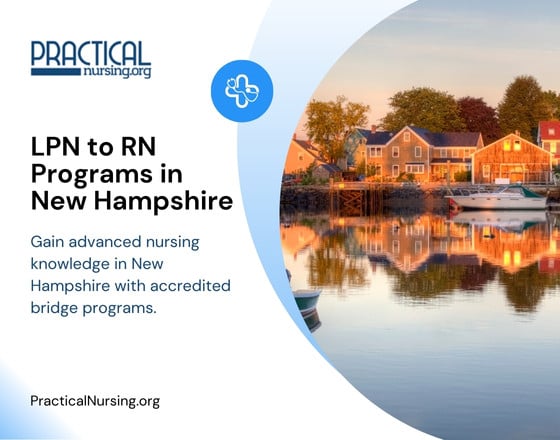
Best New Hampshire LPN to RN/BSN Programs 2026

New Hampshire’s LPN to RN bridge programs support nurses seeking to expand their roles. Students complete advanced coursework and supervised clinical practice. Programs prepare graduates for licensure and professional responsibilities as registered nurses.

Written by Jane Dewy and Edited by The PracticalNursing.org Editorial Team.
Expert Guide Verified updated on May 29th, 2025.
Edit Template
Gain advanced nursing knowledge in New Hampshire with accredited bridge programs.

2026 Best LPN to RN Programs in New Hampshire

At PracticalNursing.org, we've carefully evaluated and ranked the best Licensed Practical Nurse (LPN) to Registered Nurse (RN) programs across New Hampshire to help aspiring nurses advance their careers. Our comprehensive analysis considers program quality, student success rates, clinical opportunities, and overall educational value for nursing professionals seeking to transition from LPN to RN status. These top-rated programs offer flexible pathways, affordable tuition, and strong academic support to help nurses seamlessly bridge their educational and professional goals. Whether you're looking for online options, hybrid learning, or traditional campus-based programs, our rankings provide essential insights to guide your nursing education journey. Learn more about our ranking methodology.
#1

Rivier University

Nashua, NH - Private 4-year - rivier.edu

Associate - Nursing—LPN to ASN

Online & Campus Based - Visit Website

Rivier University's LPN to ASN bridge program offers a dynamic and accelerated educational pathway for licensed practical nurses seeking registered nurse credentials. The comprehensive 4-semester hybrid program strategically balances evening classes with flexible clinical rotations, enabling working professionals to advance their nursing careers efficiently. Students benefit from cutting-edge simulation labs and robust partnerships with regional medical centers, ensuring comprehensive hands-on training. The program's impressive 85.4% first-time NCLEX-RN pass rate underscores its commitment to academic excellence and professional preparation. Designed for motivated LPNs, the curriculum emphasizes patient-centered care, technological integration, and advanced clinical decision-making skills across diverse healthcare settings.

  • 4 Semester Program Length
  • 37 Total Credit Hours
  • Evening and Weekend Classes
  • Advanced Placement for LPNs
  • Hybrid Learning Model
  • $402/credit Nursing Courses
  • High-Tech Simulation Labs
  • Multiple Clinical Partnerships
  • 85.4% NCLEX-RN Pass Rate
#2

River Valley Community College

Claremont, NH - Public 2-Year - rivervalley.edu
Associate - LPN to RN Bridge Program

Campus Based - Visit Website

River Valley Community College's LPN to RN Bridge Program provides a strategic pathway for licensed practical nurses seeking career advancement. Uniquely structured to start in the summer semester, the program meticulously prepares students for the NCLEX-RN examination through a robust curriculum. Prospective students must hold a current LPN license and successfully complete prerequisite courses, including passing the NLN Nursing Acceleration Challenge Exam. Accredited by ACEN and fully approved by the New Hampshire Board of Nursing, the program offers comprehensive nursing education blending practical skills and theoretical knowledge. With financial aid options available and a March 31st admission deadline, this program represents an accessible and comprehensive route for LPNs transitioning to registered nursing roles.

  • Starts in summer semester.
  • Prepares for NCLEX-RN exam.
  • Requires current LPN license.
  • NLN Nursing Acceleration Challenge Exam required.
  • Full NH Board of Nursing approval.
  • ACEN accreditation.
  • Financial aid available.
  • Comprehensive nursing curriculum.
  • Practical and theoretical focus.
  • Admission by March 31st.
#3

Nashua Community College

Nashua, NH - Public 2-Year - nashuacc.edu

Associate - Nursing – Advanced Placement (NAP)

Campus Based - Visit Website

Nashua Community College's Nursing Advanced Placement (NAP) program offers a strategic pathway for Licensed Practical Nurses aiming to transition into registered nursing. The comprehensive program facilitates advanced standing for LPNs, requiring successful completion of the National League for Nursing's NACE I exam with a minimum 74% score. Students must maintain a C+ or higher in prerequisite courses and hold a current LPN license. The curriculum emphasizes comprehensive patient care techniques, foundational nursing skills, and detailed nursing process understanding. By preparing students thoroughly for the NCLEX-RN exam, this program enables LPNs to efficiently elevate their professional credentials and expand their healthcare career opportunities.

  • For LPNs seeking ADN.
  • Requires NLN NACE I exam.
  • Minimum 74% NACE I score.
  • Advanced standing available.
  • Prepares for NCLEX-RN exam.
  • C+ or higher in prerequisites.
  • Current LPN license required.
  • Focus on nursing process.
  • Patient care emphasis.
  • Foundational nursing skills.
#4

NHTI-Concord's Community College

Concord, NH - Public 2-Year - nhti.edu

Associate - Nursing – LPN to RN Completion Option

Campus Based - Visit Website

NHTI-Concord's Community College offers a strategic LPN to RN Completion Option designed for working practical nurses seeking career advancement. The four-semester program provides a streamlined educational pathway with comprehensive clinical training across diverse healthcare environments. Graduates benefit from exceptional outcomes, including a remarkable 90% NCLEX-RN pass rate and 100% job placement within nine months of completion. The curriculum emphasizes hands-on learning, integrating advanced nursing techniques with practical experience. Admission requires prerequisite science courses, ensuring students have a strong foundational knowledge in biology and chemistry. Multiple articulation agreements create seamless opportunities for continued bachelor's degree progression, making this program an attractive option for ambitious nursing professionals.

  • 4-semester LPN to RN pathway
  • 100% job placement rate
  • NCLEX-RN pass rates over 90%
  • Multiple transfer agreements available
  • Clinical experiences in hospitals/agencies
  • Comprehensive admission requirements
  • Licensed practical nurse preferred
*Data obtained from: NCES IPEDS 2023 database. https://nces.ed.gov/ipeds/

New Hampshire LPN to RN Program Overview

Eligibility and Admission Requirements

New Hampshire LPNs pursuing the RN credential typically apply to LPN to ADN or LPN to BSN bridge pathways. Common admission requirements include:

  • Current, unencumbered LPN licensure in New Hampshire or a multistate license under the Nurse Licensure Compact
  • Official transcripts from an approved practical nursing program and any colleges attended
  • Minimum GPA set by the program and completion of prerequisite courses such as anatomy and physiology I and II with labs, microbiology, English composition, psychology, lifespan or developmental psychology, and a college-level math such as statistics or algebra
  • Current Basic Life Support for Healthcare Providers certification
  • Background check, drug screen, required immunizations and titers, tuberculosis screening, and proof of health insurance for clinical eligibility
  • Standardized testing or placement measures as required by the school, for example TEAS or a program-specific placement exam
  • For working LPNs, many programs offer advanced standing through articulation policies that award credit for LPN education and recent practical experience, often contingent on competency validation

To become licensed as an RN in New Hampshire after graduation, you must meet state requirements and pass the NCLEX-RN. Refer to the New Hampshire Board of Nursing for current licensure rules, applications, and timelines.

Program Curriculum and Accreditation

LPN to RN bridge curricula build on practical nursing foundations and expand competencies in clinical judgment, leadership, and care coordination. You can expect course work and clinical experiences in:

  • Nursing transition, role development, and the RN scope of practice
  • Comprehensive health assessment across the lifespan
  • Advanced pharmacology and pathophysiology
  • Adult medical-surgical nursing, including complex and chronic care
  • Maternal-newborn, pediatrics, and family-centered care
  • Psychiatric mental health nursing
  • Community and population health, quality and safety, and evidence-based practice
  • Leadership, delegation, and interprofessional collaboration

Accreditation matters in New Hampshire because it impacts eligibility for federal financial aid, transfer of credits to higher degrees, employer recognition, and licensure mobility. Look for:

  • State approval by the New Hampshire Board of Nursing, which is required for NCLEX-RN eligibility
  • Programmatic accreditation, typically ACEN for associate degree programs and CCNE for baccalaureate programs
  • Institutional accreditation, commonly by the New England Commission of Higher Education

LPN to RN Schools and Classes

Across New Hampshire, public community colleges, private colleges, and universities offer state-approved LPN to RN options. Bridge pathways may be structured as advanced placement within an associate degree program or as an accelerated route into a baccalaureate program. Formats include daytime, evening, weekend, and hybrid delivery to support working LPNs.

Coursework typically includes a transition course that validates LPN competencies and grants advanced standing, followed by:

  • Advanced adult health and complex care with high-fidelity simulation and hospital-based clinicals
  • Mental health, pediatrics, and maternal-newborn nursing with specialty clinical rotations
  • Community health and public health nursing in home care, clinics, and community agencies
  • Leadership and management focused on delegation, prioritization, and unit-based quality improvement
  • For BSN pathways, additional study in research, informatics, population health, and health policy

Career Outlook

Registered nurses in New Hampshire practice in hospitals, critical access facilities, long-term care, ambulatory clinics, home health, behavioral health, schools, and public health agencies. Demand is influenced by an aging population, rural access needs, and employer preference for RNs in acute and specialty settings. Shift options vary by setting, with hospitals commonly using 12-hour shifts that may include nights, weekends, and holidays, while many outpatient roles offer more regular schedules.

Compared with LPN roles, RNs have a broader scope of practice that includes comprehensive assessment, independent nursing diagnoses, care planning, patient education, and coordination of complex interventions. RNs generally have higher earning potential and more pathways for advancement into specialty practice, leadership, education, and advanced practice with further education. LPNs remain vital in long-term and community-based care, but moving from LPN to RN can open access to a wider range of acute care roles and specialties.

LPN to RN Program Length

  • Full-time bridge programs: Often 12 to 18 months for the nursing sequence after prerequisites, depending on advanced standing awarded
  • Part-time programs: Commonly 18 to 30 months for the nursing sequence, allowing reduced course loads for working LPNs
  • Evening and weekend tracks: Typically 18 to 24 months for the nursing sequence, with labs and clinicals scheduled outside traditional weekday hours

Total time to completion depends on how many prerequisites you still need, transfer credit accepted, and clinical scheduling availability.

2026 Fastest LPN to RN Programs in New Hampshire

Looking at LPN to RN programs in New Hampshire, many people want to finish their studies quickly. These programs help you move up in nursing without taking too much time. The fastest and shortest options let you start working sooner. This is important because there is a big need for more nurses in places like Manchester and the Seacoast area. Programs with high graduation and retention rates show that students do well and stay on track. By choosing a quicker path, you can join the workforce faster and help fill this need in healthcare.
School NameHighlightsRetention & Grad Rates
Rivier University
  • Ranked #1 Nursing School NH
  • 4 Semester Program Length
  • 37 Total Credit Hours
  • Evening and Weekend Classes
  • Advanced Placement for LPNs
  • Hybrid Learning Model
  • $402/credit Nursing Courses
  • High-Tech Simulation Labs
  • Graduation Rate: 59%
  • Retention Rate: 76%
  • Student to Faculty Ratio: 14:1
River Valley Community College
  • Starts in summer semester.
  • Prepares for NCLEX-RN exam.
  • Requires current LPN license.
  • NLN Nursing Acceleration Challenge Exam required.
  • Full NH Board of Nursing approval.
  • ACEN accreditation.
  • Financial aid available.
  • Comprehensive nursing curriculum.
  • Graduation Rate: 31%
  • Retention Rate: 69%
  • Student to Faculty Ratio: 6:1
Nashua Community College
  • For LPNs seeking ADN.
  • Requires NLN NACE I exam.
  • Minimum 74% NACE I score.
  • Advanced standing available.
  • Prepares for NCLEX-RN exam.
  • C+ or higher in prerequisites.
  • Current LPN license required.
  • Focus on nursing process.
  • Graduation Rate: 30%
  • Retention Rate: 61%
  • Student to Faculty Ratio: 8:1
*Source: IPEDS 2023 survey results, NCES, U.S. Department of Education.

Tuition and Costs

Costs vary by institution and residency status. As a general guide in New Hampshire:

  • Public community college LPN to ADN bridges: Approximately the low teens to around twenty thousand dollars in in-state tuition for the nursing sequence, plus fees
  • University-based LPN to BSN options: Commonly several tens of thousands of dollars for the nursing portion, with total costs depending on transferred credits and length

Additional expenses include uniforms, supplies, books and digital resources, immunizations and titers, background checks and drug screens, liability insurance, BLS certification, clinical compliance services, standardized exams, and NCLEX and state licensure application fees. Housing costs in New Hampshire are higher in urban areas such as the Manchester and Nashua regions and lower in many rural communities. Community colleges typically have limited on-campus housing, so many students commute or rent off campus. Budget for transportation to clinical sites that may be spread across the state.

2026 Affordable LPN to RN Programs in New Hampshire

Finding affordable LPN to RN programs in New Hampshire is key for advancing your nursing career without high costs. These programs help you move from a licensed practical nurse to a registered nurse, offering associate or bachelor's degrees. They focus on flexible schedules and hands-on learning to fit your life. In NH, areas like Manchester and the Seacoast have options with low tuition ranges, making education more accessible. Keeping prices down means you can invest in your future without big debt. Look for economical choices to get the training you need for better job opportunities and patient care.
School NameHighlightsAnnual Estimated Tuition & Fees
River Valley Community College
  • Starts in summer semester.
  • Prepares for NCLEX-RN exam.
  • Requires current LPN license.
  • NLN Nursing Acceleration Challenge Exam required.
  • Full NH Board of Nursing approval.
  • ACEN accreditation.
  • Financial aid available.
  • Comprehensive nursing curriculum.
  • $5,600 - $8,300 (Undergrad In-State)
  • $12,200 - $18,200 (Undergrad Non-Resident)
Nashua Community College
  • For LPNs seeking ADN.
  • Requires NLN NACE I exam.
  • Minimum 74% NACE I score.
  • Advanced standing available.
  • Prepares for NCLEX-RN exam.
  • C+ or higher in prerequisites.
  • Current LPN license required.
  • Focus on nursing process.
  • $5,700 - $8,600 (Undergrad In-State)
  • $12,300 - $18,500 (Undergrad Non-Resident)
NHTI-Concord's Community College
  • 4-semester LPN to RN pathway
  • 100% job placement rate
  • NCLEX-RN pass rates over 90%
  • Multiple transfer agreements available
  • Clinical experiences in hospitals/agencies
  • Comprehensive admission requirements
  • Licensed practical nurse preferred
  • $5,800 - $8,600 (Undergrad In-State)
  • $12,400 - $18,500 (Undergrad Non-Resident)
*IPEDS 2023 institutional statistics, NCES, U.S. Department of Education.

Can I Take LPN to RN Classes Online?

New Hampshire programs increasingly use hybrid designs that deliver some didactic content online while reserving skills labs and clinical rotations for in-person learning. Fully online LPN to RN pathways are not feasible for prelicensure students because hands-on clinical education with direct patient care in approved settings is required for program approval and RN licensure eligibility. Simulation can supplement but does not replace required clinical hours.

If you consider an out-of-state online program while living in New Hampshire, confirm that the program is approved in its home state and authorized for clinical placements in New Hampshire, and that graduates are eligible for NCLEX-RN and RN licensure here. Always verify current requirements with the New Hampshire Board of Nursing.

LPN to RN Licensure Requirements in New Hampshire

NCLEX-RN Exam Information

After completing an LPN to ADN or LPN to BSN program, you must obtain RN licensure by examination in New Hampshire. Applicants submit an application to the New Hampshire Board of Nursing, provide official transcripts sent directly from the nursing program, complete state and federal fingerprint-supported background checks, and pay the required fees. Once the Board has deemed you eligible, register for the NCLEX-RN to receive your Authorization to Test, then schedule and take the exam. NCLEX results are transmitted to the Board; a passing result allows the Board to issue your RN license. If unsuccessful, you may retest according to NCLEX retake policies.

RN Reciprocity and Nurse Licensure Compact

New Hampshire issues RN licenses by endorsement to nurses who hold an active RN license in another U.S. jurisdiction. Endorsement typically requires verification of your current license, a criminal background check, and evidence of nursing education meeting New Hampshire standards.

New Hampshire is a member of the Nurse Licensure Compact. If New Hampshire is your primary state of residence and you meet eligibility criteria, you may be issued a multistate RN license that authorizes practice in all other compact states without obtaining additional licenses. If you permanently move to New Hampshire from another compact state, you must apply for a New Hampshire multistate license. New Hampshire does not maintain separate reciprocal agreements beyond the Compact; nurses from non-compact states or those without multistate privileges must apply by endorsement.

Licensure Requirements

The New Hampshire Board of Nursing regulates RN licensure under state law. For initial RN licensure by examination, you must:

  • Graduate from a Board-approved nursing education program (or a substantially equivalent program if educated outside New Hampshire; additional review may be required for international graduates).
  • Submit a completed application with fees and request official transcripts be sent directly to the Board.
  • Complete state and federal criminal background checks with fingerprinting.
  • Be found eligible and pass the NCLEX-RN.

For licensure by endorsement, you must hold an active RN license in good standing in another U.S. jurisdiction, complete the Board’s endorsement application, meet criminal background check requirements, and provide license verification and education documentation as directed by the Board.

License Renewal

New Hampshire RN licenses are renewed on a biennial cycle. To maintain active status, RNs must meet continuing competence requirements and renew before their license expiration date. Key elements include:

  • Continuing education: 30 contact hours completed during each two-year renewal period.
  • Practice hours: At least 400 hours of active nursing practice within the previous four years. Nurses who do not meet the practice-hour requirement may need a Board-approved refresher or additional steps to reestablish competency.
  • Recordkeeping: Maintain documentation of continuing education and practice hours for audit.
  • Timelines: Complete CE within the current renewal cycle and submit renewal on time; practicing on an expired license is not permitted.

For current forms, fees, and step-by-step instructions for examination, endorsement, and renewal, consult the New Hampshire Board of Nursing.

Average LPN State Salary in New Hampshire

$73,850

2024 LPN Pay reported by the Bureau of Labor Statistics.

Average RN State Salary in New Hampshire

$94,620

2024 RN Pay reported by the Bureau of Labor Statistics.

VS

LPN to ADN Bridge Program

Program Length:

Typically 12 to 24 months. For example, Lakes Region Community College offers a pathway that can be completed in 14 months, while St. Joseph School of Nursing has a 12-month track. Other programs, such as the one at NHTI-Concord's Community College, are structured over four semesters.

Credential Awarded:

Associate of Science in Nursing (ASN) or Associate Degree in Nursing (ADN).

NCLEX-RN Eligibility:

Yes, graduates are eligible to take the National Council Licensure Examination for Registered Nurses (NCLEX-RN).

Program Focus:

These programs build upon the existing knowledge of LPNs, providing an accelerated path to entry-level registered nursing roles. The curriculum is concentrated on core nursing skills, patient care, and preparing students for the NCLEX-RN exam.

Average In-State Tuition in New Hampshire:

Tuition varies by institution. For instance, River Valley Community College's in-state tuition and fees are approximately $13,723. St. Joseph School of Nursing's estimated education cost is around $18,000 for their one-year LPN to ASN track. Community colleges in New Hampshire generally offer more affordable options, with tuition around $215 per credit for in-state residents.

Best For:

LPNs who wish to become RNs quickly and cost-effectively, with the goal of entering the RN workforce as soon as possible.

School Types:

Community colleges and some private nursing schools are the primary providers of LPN to ADN bridge programs in New Hampshire. Examples include River Valley Community College, NHTI-Concord's Community College, and Lakes Region Community College.

LPN to BSN Bridge Program

Program Length:

Generally 2 to 4 years, depending on the number of transferable credits from the LPN program and other prior coursework.

Credential Awarded:

Bachelor of Science in Nursing (BSN).

NCLEX-RN Eligibility:

Yes, graduates are eligible to sit for the NCLEX-RN exam.

Program Focus:

LPN to BSN programs provide a more comprehensive education that includes all the core competencies of an ADN program, supplemented with coursework in nursing theory, research, public health, and leadership. This broader education prepares graduates for a wider range of nursing roles and future career advancement.

Average In-State Tuition in New Hampshire:

Specific in-state tuition for dedicated LPN to BSN programs in New Hampshire is not readily available, as there is a shortage of such programs within the state. Students may need to consider out-of-state online programs, where tuition rates will vary.

Best For:

LPNs who are planning for long-term career growth, leadership roles, or future graduate studies in nursing.

School Types:

There is a notable lack of specific LPN to BSN bridge programs offered by colleges and universities within New Hampshire. The New Hampshire Board of Nursing has pointed to out-of-state online programs, such as the one offered by Indiana State University, as a viable option for New Hampshire residents. LPNs in New Hampshire may also need to first complete an LPN to ADN program and then enroll in an RN to BSN completion program, which are more widely available in the state.

Choose LPN→ADN If:

  • These programs offer a quicker route to becoming a registered nurse, allowing for an earlier transition to a new role and salary.
  • The overall tuition for an ADN is typically less than for a BSN, making it a more financially accessible option for many.
  • The curriculum is intensely focused on the essential, hands-on skills needed for immediate employment in various healthcare settings.
  • Graduates can begin working as RNs and later pursue an RN to BSN bridge program, often with tuition assistance from their employer.

Choose LPN→BSN If:

  • A BSN is often required for nursing positions in leadership, public health, case management, and for roles in magnet hospitals.
  • While there is an initial investment, BSN-prepared nurses generally have a higher long-term earning potential.
  • A BSN is the necessary stepping stone for pursuing a Master of Science in Nursing (MSN) or a doctoral degree to become a nurse practitioner, clinical nurse specialist, or nurse anesthetist.
  • The curriculum provides a deeper understanding of evidence-based practice, critical thinking, and leadership within the healthcare system.

List of LPN to RN Programs in New Hampshire

If you are a Licensed Practical Nurse (LPN) in New Hampshire and want to advance your career to become a Registered Nurse (RN), you can find many programs that help you make this change. These LPN to RN programs are available in various cities across the state. They offer flexible schedules, hands-on training, and support to build on your current skills. Below is a table listing schools, their locations, program highlights, and links to learn more about each program.
Jump to City:

Claremont, NH

River Valley Community College

  • Associate - LPN to RN Bridge Program

    Campus Based - Website

    • Starts in summer semester.
    • Prepares for NCLEX-RN exam.
    • Requires current LPN license.
    • NLN Nursing Acceleration Challenge Exam required.
    • Full NH Board of Nursing approval.
    • ACEN accreditation.
    • Financial aid available.
    • Comprehensive nursing curriculum.

Concord, NH

NHTI-Concord's Community College

  • Associate - Nursing – LPN to RN Completion Option

    Campus Based - Website

    • 4-semester LPN to RN pathway
    • 100% job placement rate
    • NCLEX-RN pass rates over 90%
    • Multiple transfer agreements available
    • Clinical experiences in hospitals/agencies
    • Comprehensive admission requirements
    • Licensed practical nurse preferred

Nashua, NH

Nashua Community College

  • Associate - Nursing – Advanced Placement (NAP)

    Campus Based - Website

    • For LPNs seeking ADN.
    • Requires NLN NACE I exam.
    • Minimum 74% NACE I score.
    • Advanced standing available.
    • Prepares for NCLEX-RN exam.
    • C+ or higher in prerequisites.
    • Current LPN license required.
    • Focus on nursing process.

Rivier University

  • Associate - Nursing—LPN to ASN

    Online & Campus Based - Website

    • Ranked #1 Nursing School NH
    • 4 Semester Program Length
    • 37 Total Credit Hours
    • Evening and Weekend Classes
    • Advanced Placement for LPNs
    • Hybrid Learning Model
    • $402/credit Nursing Courses
    • High-Tech Simulation Labs
*Data provided by: National Center for Education Statistics, IPEDS 2023 collection.