LPN programs have settled into a compressed, high-stakes model: most students complete 400 to 950 hours of clinical training inside 12 to 18 months of full-time study as part of their LPN career path. In 2026, the NCLEX-PN test plan also tightened, reducing the maximum exam length from 205 items to 150, which puts more weight on first-attempt preparation.
For the CNA stepping up, the career changer, or the parent retraining on a tight schedule, the challenge is rarely the material itself. It is the collision of tuition bills, rent, and 15 to 18 weekly contact hours before study time even starts. Passing requires treating the process as a fixed, non-negotiable window rather than a flexible credential.
What You Learn in LPN School: Core Courses and Curriculum Sequence
What you learn in LPN school follows a sequence that moves from classroom foundations to supervised patient care. Most programs start with nursing fundamentals, anatomy and physiology, medical terminology, patient safety, and infection control. Coursework then advances into adult medical-surgical nursing, pharmacology, dosage calculation, and medication administration. Pediatrics, maternal-newborn care, mental health nursing, and nutrition usually follow. Some programs close with community health LPN rotations or a practicum under a licensed nurse.
Whether you attend a traditional on-campus cohort or one of the accredited Hybrid LPN Programs, the core courses remain similar because state boards expect the same competencies for NCLEX-PN eligibility. Expect to spend time in the skills lab before you handle real patients: you’ll practice vital signs, wound care, catheters, tube feedings, and documentation. Clinical rotations then pair each classroom topic with supervised patient care in long-term care, hospitals, clinics, or community settings. Your clinical instructor, usually an RN or experienced LPN, observes your communication, safety, and time management as much as your technical skills. Most full-time practical nursing programs deliver this sequence in consecutive terms, while part-time pathways spread the same content over more time without reducing clinical hours.
What you learn in LPN school is organized to build entry-level practice, not specialization. You may be tested on scope-of-practice boundaries, delegation, and legal and ethical responsibilities in every course. Keep a running drug guide and practice dosage calculations early; they appear across the curriculum and on the NCLEX-PN. If a subject feels overwhelming, use the same structure many successful students rely on: preview before class, create active notes, form a small study group, and schedule weekly review instead of cramming. Your instructors and clinical preceptors want to see steady progress, so ask questions and review skills checklists before each lab or clinical day.
What a Typical Week in LPN School Looks Like
LPN programs are structured as full-time commitments, and the weekly rhythm reflects that. There is no single national schedule, but published LPN/LVN program admissions information gives a consistent picture: expect somewhere between 15 and 18 contact hours a week on campus and clinical sites, plus roughly double that in independent study once you account for readings, care plans, and exam prep.
Contact Hours: What Programs Actually Schedule
North Central Michigan College's PN program tells students to plan on 15 to 18 contact hours per week, then adds another two hours of study for every contact hour, landing at a total weekly commitment of 45 to 54 hours.1 That is the clearest published breakdown available, and it is comparable to a full-time job with substantial overtime.
Other programs frame it in total hours rather than weekly averages. Shelton State's PN track runs 480 theory hours, 195 lab hours, and 360 clinical hours across roughly three semesters, with students specifically told to plan on 12 to 15 clinical hours per week.2 Colorado Mesa's program totals 300 theory, 75 lab, 60 simulation, and 450 clinical hours.3 CVES runs 630 classroom, 95 lab, and 530 clinical hours over the full program.4
Early Terms Versus Later Terms
The weekly mix shifts as you progress. Early terms lean heavily on lecture and skills lab: fundamentals, pharmacology, anatomy, and basic nursing skills practiced in a controlled setting. Clinical days may be limited to observation or one short shift per week.
By the middle and final terms, clinicals dominate. Two or three shifts a week of 8 to 12 hours in long-term care nursing or at hospitals and clinics is typical, with classroom time compressed into one or two remaining days. This is when care plans, medication administration records, and clinical paperwork start eating evenings.
The Homework Load
Study expectations are quantified in most handbooks. Lorain County Community College tells PN students to plan on two to three out-of-class hours per instructional hour.5 Western Nebraska Community College applies the standard credit-hour rule of three hours weekly per lecture credit.6 In practical terms, that means daily reading assignments, weekly drug calculation practice, care plans during clinical terms, and ongoing NCLEX-PN style question review.
Most programs run Monday through Friday, with occasional weekend clinical rotations. Evening and weekend tracks for working adults exist but are the exception, not the norm.
Clinicals, Skills Labs, and Simulation: The Hands-on Side of LPN Training
How many hours will you actually spend caring for real patients before you graduate? The answer depends heavily on your state and program, but most LPN/LVN students log somewhere between 400 and 950+ LPN clinical hours, layered on top of skills lab and simulation work.
Where Clinical Rotations Happen
Most programs start students in long-term care or skilled nursing facilities, where the pace is slower and the resident population offers repeated practice with basic care skills. From there, students typically rotate into hospital med-surg floors, outpatient clinics, and often a maternity or pediatric unit, gaining experience in the inpatient vs. outpatient setting. Texas programs, for example, report roughly 207 hours in acute care and 144 hours in long-term care as typical averages, though programs set their own totals and can require more. Florida programs generally split experience so that clinical time makes up about half of total instructional hours, translating into several hundred hours minimum. Pennsylvania sets one of the higher bars, requiring 900 clinical hours within a 1,500-hour curriculum delivered over at least 12 months.
Skills Check-Offs Before Touching a Patient
Before students are cleared for hands-on care in any new setting, they must demonstrate competency on specific procedures, vital signs, wound care, catheterization, injections, NG tube insertion, in a controlled skills lab. These check-offs are typically pass/fail with zero tolerance for critical errors: missing a safety step, like failing to verify patient identity or contaminating a sterile field, usually means an automatic redo regardless of how well the rest of the procedure went.
Simulation's Growing Role
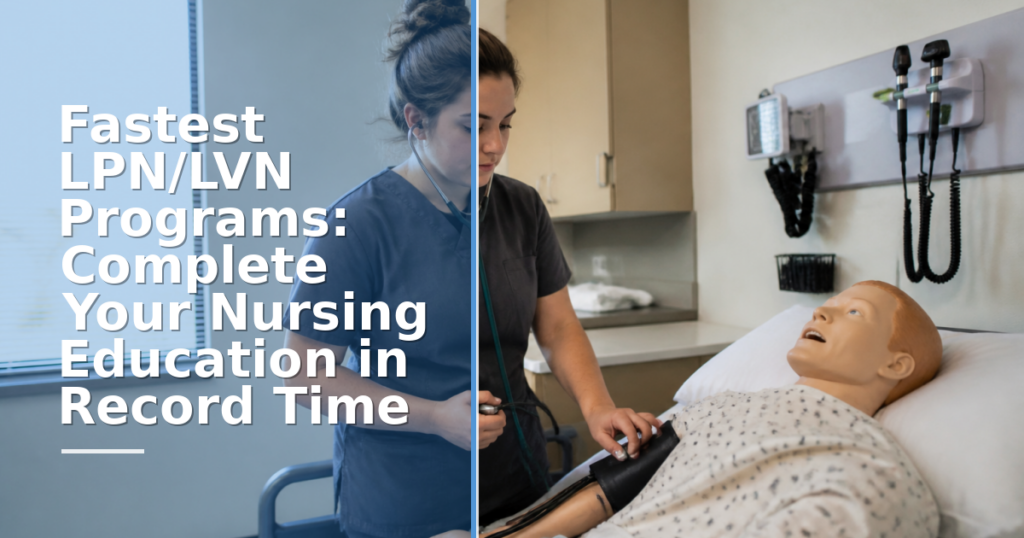
High-fidelity mannequins that breathe, respond to medication, and simulate deteriorating vital signs let students rehearse scenarios, medication administration, and emergency response before ever facing the real thing. Increasingly, states allow a portion of required clinical hours to be met through simulation rather than live patient contact. California caps this substitution around 25%, Texas and Florida allow up to 50%, and Georgia permits up to 75% specifically for obstetrics and pediatrics rotations. Illinois follows the more conservative 25% figure as well. These percentages are typically capped per course or rotation, not simply subtracted from the total, so check your specific program's structure rather than assuming the maximum applies everywhere.
State-by-State Clinical Hour Requirements for LPN Programs
Clinical hour requirements for LPN and LVN programs vary widely. Some state boards of nursing set explicit minimums, while others leave the total to individual programs as long as curriculum objectives are met. The table below covers key high-enrollment states where verifiable regulatory data is available. For states not listed, check your state board of nursing directly, as requirements change and several boards have not published a single public minimum.
| State | Minimum Clinical Hours | Simulation Hours Allowed | Notes |
|---|---|---|---|
| California | 954 hours | Not specified in available data | The Board of Vocational Nursing and Psychiatric Technicians requires at least 954 clinical hours plus 576 theory hours for LVN licensure. |
| Texas | No board-mandated minimum | Yes, up to 50% per clinical course | The Board of Nursing does not prescribe a total minimum. Programs determine hours sufficient to meet objectives. Statewide survey data shows a median of roughly 787 total clinical contact hours across VN programs. |
| New York | Not publicly specified as a single number | Yes, per Commissioner's regulation 52.12 | Simulated experience meeting state standards counts as clinical education. Guidance for RN programs references a one-third cap on simulation, but the exact LPN percentage is not explicitly stated in publicly available summaries. |
| Georgia | Not publicly specified as a single number | Yes, but limited to obstetrics and pediatrics | Simulation may replace up to 75% of required clinical hours in obstetrics and pediatrics courses only. All other clinical areas require traditional, in-person clinical placements. |
| Michigan | Not publicly specified as a single number | Yes, up to 50% of each clinical experience | Administrative rules cap simulation at 50% of each clinical rotation, with one exception: obstetrics and pediatrics courses may use simulation for up to 100% of clinical hours. |
How Hard Is LPN School? Workload, Grading, and Attrition Rates
If you're wondering how hard is LPN school, the answer is a full-time academic workload compressed into 12 to 18 months, and the numbers back up what students already suspect: it's demanding. Nationally, LPN program completion rates run somewhere between 60% and 90%4 depending on the school, which means attrition (students who withdraw, fail out, or stop out) can range from 10% to 40%4 at some programs. There isn't one clean national attrition figure the way there is for licensing exams, but the spread itself tells you outcomes vary a lot by school, so vetting a program's track record matters before you enroll.
What the Pass Rates Actually Show
On the licensing side, NCLEX-PN first-time pass rates for U.S.-educated candidates have hovered in the mid-to-high 80s recently, around 86.7% in 20231 and 88.4% in 20242. That figure drops when every candidate (including repeat test-takers and internationally educated nurses) is counted together, landing closer to 79% in 20243. State-level results can swing further in either direction. Maryland, for example, reported a 96% first-time pass rate in FY2024 for its own graduates4. Treat any single statistic as a snapshot, not a guarantee, and ask prospective schools for their own recent numbers.
Grading Is Stricter Than a Typical College Class
Most accredited LPN programs set the passing bar well above the standard 70% college cutoff. Community college programs commonly require 77% in nursing courses, vocational and technical schools often use 78%, and hospital-based or proprietary programs sometimes require 80%, usually citing patient safety as the reason.5 A minimum GPA of 2.0 to 2.5 is typical for overall progression.5 Fall below the threshold in one course and you're likely looking at remediation or a mandatory repeat, not just a low grade on a transcript.
Remediation Isn't the End of the Road
Most programs allow one course failure with a chance to repeat it, often after remediation coursework or extra lab time. A second failure, or failing the same course twice, usually triggers dismissal, though many schools permit reapplication after a waiting period. Knowing this upfront lets you plan rather than panic if a single exam or clinical evaluation goes sideways.
How It Compares to RN Programs
If the question is is becoming an LPN worth it, LPN coursework skips the heavier science load, typically no organic chemistry or microbiology, and clinical complexity stays narrower than RN training. But because the timeline is so compressed, the volume of material per month is intense, which is exactly why grading thresholds run high.
LPN Program Attrition and NCLEX-PN Pass Rates at a Glance
These five benchmarks capture the difficulty and pace of practical nursing education. Understanding them before you start helps you set realistic expectations and build a study plan that keeps you on track through graduation and licensure.

Working While in LPN School: Realistic Strategies for Balancing Work and Study
The central tension for most LPN students is straightforward: you need income to pay for the LPN program cost, but the hours you spend earning that income directly compete with the study time you need to finish. Navigating this tradeoff requires honest planning, not wishful thinking.
How Many Hours Can You Realistically Work?
Most full-time LPN programs advise students to cap paid employment at 15 to 20 hours per week, and many program handbooks explicitly discourage full-time jobs. This is not arbitrary gatekeeping. Between lectures, clinical rotations, skills labs, and independent study, a typical week already demands 45 to 54 hours of your time. National survey data on nursing students consistently shows that those who work more than 20 hours per week report lower exam scores and higher rates of program withdrawal. If your finances allow it, fewer hours of paid work will almost always translate into a stronger academic outcome.
Jobs That Actually Help Your Training
Not all side work is created equal. Some roles reinforce what you are learning in the classroom:
- CNA or PCT shifts: Hands-on patient care builds the clinical instincts your instructors are testing you on. Many employers also offer tuition assistance.
- Per-diem or weekend-only positions: These let you protect weekday study blocks while still earning.
- Healthcare-adjacent roles: Front-desk or scheduling positions in clinics keep you in the medical environment with more predictable hours.
Tactical Study Strategies for Working Students
- Batch your heaviest study sessions on clinical-free days rather than spreading thin across every evening.
- Use commute time for audio pharmacology reviews or recorded lecture playback.
- Lock in a weekly study group that meets on the same day and time so it becomes non-negotiable.
- Negotiate a reduced work schedule before your program starts. Asking mid-semester, when you are already falling behind, gives you far less leverage.
Funding That Eases the Pressure to Work
Many LPN students are adult learners supporting families, so "just work less" is easier said than done. Look into the Most Affordable LPN/LVN Programs and these funding options early:
- Pell Grants: Federal aid that does not need to be repaid, available at most accredited programs.
- WIOA funding: Workforce Innovation and Opportunity Act programs, administered through local American Job Centers, often cover tuition and even living expenses for qualifying students.
- Employer tuition assistance: Hospitals and long-term care facilities frequently reimburse CNA employees who enroll in LPN programs, sometimes in exchange for a post-graduation work commitment.
The goal is to minimize financial stress without sacrificing the academic performance that earns you a license. Start the conversation about money and scheduling months before orientation, not after the first failed exam.
LPN Program Costs: Tuition, Fees, Supplies, and Financial Aid
What does an LPN program actually cost once you add up tuition, gear, exam fees, and background checks? The honest answer is that it varies more than most prospective students expect, and the sticker price rarely matches what you actually pay after aid.
Tuition by Program Type
As a practical overview (not an exhaustive breakdown), tuition tends to fall into three tiers:
- Community college programs: roughly $4,000 to $15,000 total, often the lowest-cost path if you qualify for in-district rates.
- Vocational and technical schools: roughly $10,000 to $20,000+, often shorter and more schedule-flexible than college programs.
- Private and for-profit programs: $15,000 to $40,000+, sometimes higher. These can offer faster starts and rolling enrollment, but the net price after aid deserves close scrutiny.
Focus on net cost, not sticker price. A $22,000 program that stacks grant aid can end up cheaper than a $9,000 program that offers none.
The Costs Students Forget to Budget
Beyond tuition, most programs pass through a predictable set of add-ons:
- Scrubs and uniforms: $100 to $300
- Stethoscope, penlight, and skills supply kit: $150 to $400
- Textbooks and digital course access: $500 to $1,200
- Background check and drug screening: $75 to $200
- Clinical site fees, immunizations, CPR certification, and liability insurance (varies)
- NCLEX-PN fees through Pearson VUE: $200 for the 2025-2026 cycle
State licensure fees are separate and vary widely. For example, Maine charges a $75 application fee plus $52 for the criminal background check1; South Carolina's application fee is $702; Iowa's practical nurse exam application is $93 with a $50 fingerprint/background processing fee3; Kansas charges $57 for background processing4; and Minnesota's combined state and federal background check is $32.5 Check your own board of nursing for the current figures before you apply.
Financial Aid Worth Pursuing
Aid can meaningfully shrink the bill if the program participates in federal Title IV funding:
- Federal Pell Grant maximum and minimum award amounts: up to $7,395 for 2025-2026 (minimum $740), and it does not have to be repaid.
- WIOA grants through your state workforce board, often targeted at healthcare training.
- State vocational rehabilitation funding for eligible students.
- Employer tuition reimbursement from hospitals and long-term care facilities, sometimes in exchange for a work commitment.
- Nursing-specific scholarships from state nurses associations and private foundations.
For a deeper tuition comparison across schools and states, see the dedicated LPN program cost guide.
From Graduation to Licensure: NCLEX-PN, ATT, and State Board Applications
The NCLEX-PN exam entered 2026 with a revised test plan that reduces the maximum exam length from 205 items to 150, but the licensing sequence itself remains familiar: graduate, clear state requirements, test, and get issued a license.
The Licensing Pipeline in Order
- Graduate and clear your program: Your school submits final transcripts and completion records to the state board once you finish.
- Apply to your state board: Submit the licensure application and any required documents, including fingerprint-based background checks if your state requires them.
- Receive your Authorization to Test (ATT): The board issues the ATT after approving your file.
- Register with Pearson VUE and schedule: Pay the $200 exam fee and book a seat through Pearson VUE. The ATT is typically valid for 90 days.
- Sit for the NCLEX-PN: Arrive on time. Candidates arriving more than 30 minutes late may forfeit the appointment.
- Receive results and license: Official Quick Results are usually available within 48 hours for $8.00, and the state board issues the license after a pass, clearing you to begin working as a licensed practical nurse.
ATT Timing and Where Delays Happen
There is no reliable official state-by-state ranking of ATT wait times for 2025-2026. Broadly, processing commonly takes 1-4 weeks, often 3-8 weeks overall, and can stretch to 8-12 weeks when files are incomplete, background checks lag, or boards are flooded around May-July graduation peaks. Anecdotal reports describe Texas as faster, often 10-15 business days for clean files, while Pennsylvania, Illinois, and Massachusetts have been slower during peak periods, and Puerto Rico and the U.S. Virgin Islands can take longer still. Treat these as informal patterns, not board benchmarks.
NCLEX-PN Format and Scheduling
The 2026-2029 test plan keeps the computer-adaptive format. Most exams run 85 to 150 items within a five-hour testing window, and scored case study sets are included. Individual exam content can vary up to 3 percent by category because of variable-length adaptation. Schedule as soon as the ATT arrives because May-July slots fill quickly. Repeat candidates cannot reschedule until 45 days after a failed attempt. The current U.S. fee is $200 for 2025-2026. Pearson VUE has announced an increase to $350 effective February 1, 2027.
Background Checks and the Final Weeks
Most states require fingerprint-based criminal background checks. Minor infractions rarely disqualify a candidate, but undisclosed convictions can, so disclose accurately on the application. Begin the background check during the final term rather than after graduation; it is a common source of delay. Unofficial quick-result workarounds float around after the exam, but Quick Results is the official channel, and your board remains the source for the license itself.
The Graduation-to-License Timeline
After you walk out of your LPN program's final class, there is still a defined sequence of steps before you can practice. Most graduates hold an active LPN license within 4 to 10 weeks of graduation, though your state board's processing speed is the biggest variable.

Related Articles
What LPNs Actually Earn: Salary Data by State
All the late nights, tough exams, and clinical rotations covered in earlier sections lead to a tangible payoff. According to the most recent Occupational Employment and Wage Statistics from the U.S. Bureau of Labor Statistics (2025), licensed practical and vocational nurses earn a national median that varies significantly by state. The table below shows the 25th percentile (typical for newer LPNs), the median, and the 75th percentile (common for experienced nurses or those in high-demand settings), giving you a realistic picture of what to expect as you move from student to licensed professional.
| State | Total Employment | 25th Percentile | Median Salary | 75th Percentile |
|---|---|---|---|---|
| Washington | 6,780 | $76,920 | $83,150 | $93,970 |
| Alaska | 290 | $70,490 | $80,800 | $87,380 |
| Oregon | 4,260 | $73,040 | $80,470 | $90,690 |
| Massachusetts | 13,210 | $72,610 | $80,220 | $84,570 |
| Rhode Island | 1,290 | $77,890 | $80,090 | $81,170 |
| California | 82,850 | $74,840 | $79,750 | $93,720 |
| New Hampshire | 2,220 | $67,650 | $77,110 | $82,760 |
| Arizona | 6,530 | $66,770 | $77,070 | $81,860 |
| Nevada | 3,350 | $65,930 | $76,160 | $79,570 |
| District of Columbia | 1,040 | $63,960 | $75,740 | $81,400 |
| New Jersey | 17,410 | $66,890 | $75,160 | $79,980 |
| Illinois | 17,440 | $63,580 | $75,000 | $79,560 |
| Maryland | 9,560 | $65,300 | $74,660 | $79,670 |
| Colorado | 4,920 | $61,890 | $73,880 | $79,800 |
| Connecticut | 8,540 | $66,660 | $73,690 | $76,830 |
| Maine | 760 | $63,530 | $73,200 | $77,420 |
| Hawaii | 840 | $62,460 | $71,140 | $75,250 |
| Vermont | 1,130 | $61,490 | $69,930 | $78,230 |
| Delaware | 2,240 | $64,420 | $68,710 | $75,020 |
| New York | 39,400 | $61,400 | $67,180 | $76,960 |
| Indiana | 14,480 | $61,060 | $65,720 | $73,430 |
| Michigan | 10,880 | $62,050 | $65,460 | $73,880 |
| Virginia | 15,550 | $59,610 | $64,920 | $74,540 |
| Pennsylvania | 38,260 | $60,350 | $63,940 | $72,810 |
After You Pass: Starting Your First LPN Job and Career Pathways
The shift from student to licensed practical nurse brings a near-term tradeoff: the quickest job offers usually sit in long-term care, while roles that may lead to more opportunities later often ask for experience you do not have yet. Passing the NCLEX-PN does not remove that tension; it moves it from the classroom to the job market. The right first job does not have to be your forever job; it has to give you clean experience, confident skills, and a paycheck while you decide what is next.
Your First Weeks on the Job
Most new LPNs complete a structured orientation lasting four to twelve weeks, depending on the employer. In skilled nursing facilities, orientation usually pairs you with a preceptor while you learn medication passes, wound care routines, documentation, and the facility's emergency procedures. Hospitals often add modules on telemetry, IV therapy, and interdisciplinary rounds, while clinic orientations focus on rooming patients, point-of-care testing, and phone triage protocols. Expect skills checkoffs and competency sign-offs before you practice independently.
Where New LPNs Typically Start
According to U.S. Bureau of Labor Statistics data, skilled nursing and long-term care facilities remain the largest employers of LPNs, and they are often the easiest entry point for new graduates. These employers hire year-round, maintain predictable shift schedules, and build their orientation around new nurses. Hospital medical-surgical units and outpatient clinics may prefer six to twelve months of experience before hiring an LPN, especially in regions with strong nursing school pipelines. A first job in long-term care can therefore serve as a practical bridge to those settings later.
Building Toward an RN
Many LPNs begin an LPN-to-RN bridge program after one to two years of practice. Bridge programs, including LPN to ADN Programs, give credit for LPN coursework and clinical experience, allowing you to earn an ADN or BSN in roughly twelve to eighteen months instead of restarting a full two- or four-year nursing degree. The timeline is shorter because the program assumes you already hold core practical nursing competencies. Some states also offer dual enrollment options while you are still working full-time.
The LPN License as Both Destination and Launchpad
LPN experience strengthens RN school applications, and many employers offer tuition reimbursement or loan repayment for LPN-to-RN advancement. Some nurses stay in practical nursing for decades, moving into charge nurse, MDS coordinator, or wound care roles, often through Leadership Opportunities for LPNs. Others use the LPN license to offset the cost and time of an RN degree. Either path is legitimate, and the choice often depends on your long-term goals, family obligations, and local job market.