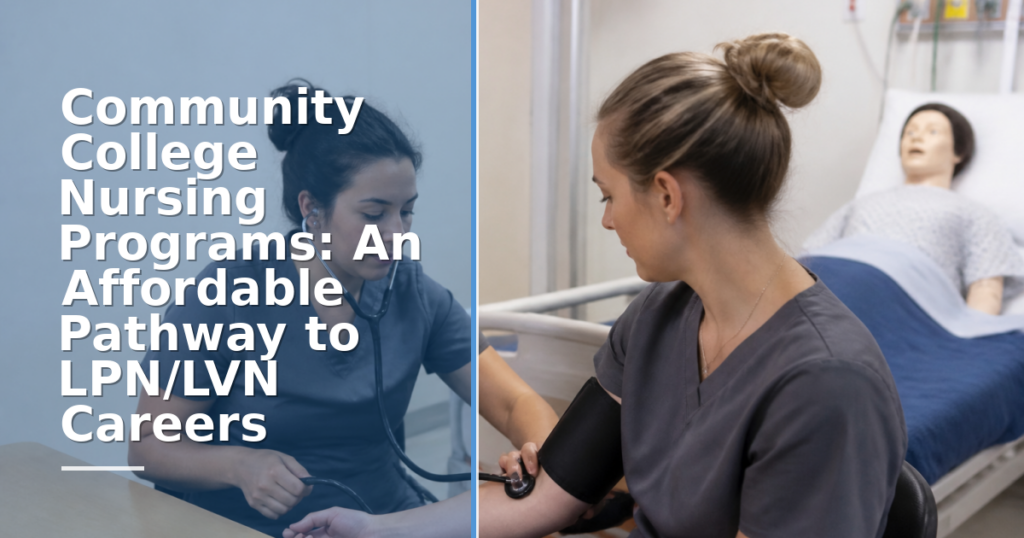


A small but real subset of RN and BSN students never wait for graduation day to become nurses. Depending on the state board and how a program sequences its courses, some students sit for the NCLEX-PN partway through a longer degree, walking away with an LPN credential a year or more before their classmates finish.
That option sits alongside the standard path for those considering LPN school: 12 to 18 months of pharmacology, anatomy, and hands-on clinical rotations, followed by NCLEX-PN and state licensure.
Both routes lead to the same license, but eligibility rules, accreditation requirements, and course sequencing differ enough by state and school that assuming your program works like a friend's elsewhere can cost you a semester.
Can You Take the LPN Exam While Still in RN or BSN Nursing School?
Some RN, BSN, and ADN programs build in a point, usually after the first year or two, where a student can pause the RN track and sit for the NCLEX-PN as a practical nurse.2 Pass it, and that student walks away with an LPN license while still working toward the RN degree. It sounds like a smart shortcut, and in the programs that still offer it, it can be. But it is nowhere near a national standard,1 and treating it as an expected option can set students up for disappointment.
Not a Guaranteed Pathway
Whether mid-program testing is possible comes down to two things working together: the state board of nursing has to permit it, and the nursing school has to have an approved curriculum pathway, typically through Accredited LPN and RN Programs, built around it.3 Neither piece alone is enough. A state that allows the practice still requires the school to structure its courses to meet PN-level competencies partway through, and a school with that curriculum still needs its state board's sign-off. Evidence from programs and boards around the country suggests this combination is becoming less common, not more.3 Many schools that once supported it have quietly stopped.
Why Students Still Ask About It
The appeal is obvious. Earning LPN wages while finishing an RN or BSN degree eases the financial pressure of a multi-year program, and it puts a nursing license, and real clinical responsibility, in hand years earlier than waiting for RN graduation. For students juggling tuition, family obligations, or a slow financial runway, that early income can matter a great deal.
The School Certifies, Not the Student
Here is the part students often misunderstand: eligibility is never something a student can self-declare.3 The nursing department has to formally attest to the state board that the student has completed the specific coursework and clinical hours equivalent to practical nursing education.3 Without that certification from the program itself, the board will not authorize the exam application, no matter how confident or prepared the student feels. If your ADN or BSN program does not already have this pathway built and board-approved, asking to test out mid-program generally will not work.3
Because policies vary so much by state and by individual school, the state-by-state breakdown below is the place to check specifics before assuming this option applies to you.
State-By-State LPN Exam Eligibility for Nursing Students
Policies on whether RN, BSN, or ADN students can sit for the NCLEX-PN before finishing their program vary dramatically from state to state. The table below summarizes what is currently known for selected states. Because most boards of nursing tie NCLEX-PN eligibility to completion of an approved practical nursing program, the mid-program pathway remains uncommon. Always confirm the latest rules directly with your state board of nursing before making enrollment or testing decisions.
| State | Can RN/BSN/ADN Students Sit for NCLEX-PN Mid-Program? | Key Requirements or Notes |
|---|---|---|
| Alabama | Yes, with conditions | ADN students become eligible for NCLEX-PN after successful completion of all third-semester coursework. The school certifies eligibility, but the Alabama Board of Nursing grants final approval. Applicants must also clear criminal background and identification requirements. |
| Arkansas | No specific allowance described | Arkansas State Board of Nursing standards frame eligibility around completion of an approved nursing program, not mid-program status. Graduates of approved PN programs take the NCLEX-PN; graduates of RN programs take the NCLEX-RN. |
| Texas | No policy identified in current rules | Texas Board of Nursing rules focus on graduates of approved PN programs taking the NCLEX-PN. No provision in the cited rules authorizes RN or ADN students to challenge the PN exam mid-program. PN programs must maintain at least an 80% first-time NCLEX-PN pass rate. |
| Washington | No explicit provision | Washington State Board of Nursing requires an Authorization to Test (ATT) before any candidate can sit for NCLEX. The ATT process is tied to meeting full board licensure eligibility requirements, with no separate pathway noted for RN students seeking mid-program PN testing. |
| Massachusetts | No pathway described for ADN students | State board guidance (reflected in PN program handbooks) associates the NCLEX-PN with PN program graduates and the NCLEX-RN with ADN graduates. Students may not use the LPN or RN title until they pass the corresponding NCLEX exam. |
| Most U.S. jurisdictions (general rule per NCSBN model) | Not supported under standard model rules | NCSBN Model Rules state that all LPN/VN applicants must pass the NCLEX-PN and implicitly assume candidates are graduates of approved PN programs. The model rules do not include a provision for RN, BSN, or ADN students to sit for the NCLEX-PN mid-program. |
| States allowing RN graduates to seek PN licensure (select jurisdictions per NCSBN survey) | Possible after RN program completion, not mid-program | The 2024 NCSBN Licensure Survey indicates that some jurisdictions allow graduates of RN programs to pursue practical nursing licensure if they meet specific state requirements. However, this applies to graduates, not to students still enrolled mid-program. |
| All states (national overview) | Eligibility generally tied to program completion | Across the country, the standard first step toward licensure is completing a nursing education program that meets the state board's standards, then applying to sit for either NCLEX-RN or NCLEX-PN. Candidates may take the NCLEX in any state regardless of where they plan to practice. |
Accreditation and Course-Sequencing Rules That Allow Mid-Program LPN Testing
The tension here is between flexibility and oversight. A handful of programs let a student sit for the NCLEX-PN before the final diploma is in hand, but that flexibility never comes from state law alone. It comes from the accreditation and approval status of the specific school, combined with an administrative arrangement between that school and its board of nursing.
Accreditation Comes First
Before any conversation about early testing can happen, the program itself has to hold accreditation recognized by the state board, whether that's full approval or, in some cases, an accepted candidacy status while a newer program works toward full standing. Board approval and accreditation status are reviewed separately, and a program can carry one without the other fully finalized. Either way, the accrediting and approving bodies determine whether the school qualifies to make any early-testing arrangement at all. A program without that standing has no path to offer, regardless of what courses a student has finished.
Course Sequencing Is a Program Detail, Not a Guarantee
Where schools do build in a mid-program option, they typically require students to have finished the heaviest gatekeeper coursework first: fundamentals of nursing, pharmacology, and med-surg I are the courses most often cited. The logic is that these three build the clinical judgment base the NCLEX-PN tests, and the Complete Guide to LPN/LVN Clinical Rotations examines that base in practice. But this sequencing is set by the individual program, not a nationwide standard, so a student should never assume that finishing pharmacology automatically opens the door to registration.
Verification Comes From the School, Not the Student
Students don't submit their own eligibility paperwork in these arrangements. The dean, program director, or registrar formally verifies to the board that the student has met the program's internal benchmarks. That verification is what triggers eligibility, not a self-reported transcript.
It's an Agreement, Not a Statute
Most of these arrangements rest on a memorandum of understanding between the individual school and its state board rather than a broad rule written into law. That means the same coursework completed at one school may qualify a student elsewhere for nothing at all. Anyone counting on early testing should confirm, in writing, exactly what their specific program and board have agreed to before making any plans around it.
Weighing the Risks of Testing Out Mid-Program
Is testing out for LPN licensure mid-program actually worth the cost and hassle? For some students, yes. For others, it adds strain to an already demanding course load without a clear payoff.
The Real Cost Adds Up
Sitting for the NCLEX-PN isn't free, and it isn't just the exam fee. Students budget for the national exam cost, a separate state licensing application fee, and often a review course or question bank to prepare properly on top of RN coursework. That prep time matters more than the dollar amount for most people: carving out hours to study for a second licensing exam while still attending ADN or BSN clinicals and lecture means something else gets less attention, usually sleep or study time for upcoming RN exams.
Two Licenses, Two Sets of Rules
Once you're an LPN, you're accountable to your board of nursing as a licensed professional, not just a student. That means renewal deadlines, continuing education requirements, and scope-of-practice rules apply to you even while you're still enrolled in RN school. Juggling two license renewal cycles, and potentially two sets of CE obligations if you move states, is an administrative burden that catches some new LPNs off guard. Missing a renewal window because you were buried in RN clinicals is a preventable but common problem.
Don't Let It Slow Down Your RN Progress
The biggest risk isn't financial, it's momentum. Working LPN shifts while enrolled in an RN program can chip away at the time and focus your ADN or BSN coursework demands. Some students find the income and clinical experience sharpens their RN studies. Others find themselves falling behind, extending their program timeline, or burning out before they reach the finish line they actually enrolled for.
When It Makes Sense
Testing out mid-program is worth serious consideration when a student needs income sooner, whether to support a family or reduce loan debt, or wants a backup credential in case RN school gets interrupted. It's not a shortcut everyone should take. Talk with your program director and your state board before committing, and be honest about whether you have the bandwidth to carry two licenses at once.
Related Articles
What You'll Learn in LPN Coursework and Clinicals
LPN school is built around two halves that work together: classroom instruction that teaches the science behind patient care, and LPN/LVN clinical rotations where you practice that knowledge on real people under supervision. Neither half stands alone. A student who memorizes drug classifications but never touches a blood pressure cuff isn't ready for a floor, and one who's comfortable at the bedside but shaky on anatomy will struggle with the NCLEX-PN.
Core Coursework You Can Expect
Most programs sequence classroom content around the body systems and the patient populations you'll eventually serve.
- Anatomy and physiology: how organs and systems function and fail, the foundation for everything else.
- Pharmacology: drug classes, dosage calculation, side effects, and safe administration.
- Nutrition: how diet affects healing, chronic disease management, and specialized diets.
- Medical-surgical nursing: care for adult patients before and after procedures, and management of chronic illness.
- Pediatrics: growth and development, common childhood illnesses, and age-appropriate care.
- Maternal-newborn care: labor, delivery, postpartum recovery, and newborn assessment.
Clinical Rotations: Where Theory Meets Practice
Clinical hours place students in hospitals, long-term care and nursing home settings, and outpatient clinics, working alongside licensed staff. Rotations typically move through different units so you get exposure to varied patients rather than repeating the same routine. This is where a lecture on wound healing becomes a dressing change you perform yourself, with an instructor watching your technique.
Skills You'll Actually Practice
Clinical and skills-lab time centers on the tasks you'll do every shift once licensed:
- Taking and documenting vital signs accurately
- Performing basic and advanced wound care
- Administering medications safely, including calculating correct dosages
- Charting patient documentation that holds up to legal and clinical scrutiny
A Typical Week
Weekly schedules vary by program, but most students split time three ways: classroom lecture, hands-on skills lab practicing techniques on mannequins or peers before touching real patients, and supervised clinical shifts in an actual care setting. Early terms lean heavier on classroom and lab; later terms shift weight toward clinicals as students take on more responsibility. Expect full days, not casual drop-in classes. Programs that shortchange clinical hours in favor of extra lecture time are worth questioning, since hands-on competency is what state boards and future employers in licensed practical nurse careers are actually testing for.
Clinicals are where everything clicks. You can memorize drug calculations and care plans in a classroom, but it is not until you are standing at a patient's bedside, checking vitals and communicating with the care team, that theory turns into real nursing skill.
LPN Program Length at a Glance
For readers searching "lpn years of school," the answer is refreshingly short compared to most healthcare credentials. A full-time LPN program typically wraps up in 12 to 18 months, though accelerated tracks can compress that to as few as 9 or 10 months. Part-time evening and weekend schedules, on the other hand, may stretch the timeline to about 24 months. Either way, you are looking at roughly one calendar year of intensive study and clinicals before you sit for the NCLEX-PN.

LPN Class Requirements and Program Accreditation Standards
What does it actually take to get into an LPN program, and how do you know if the one you're eyeing is legitimate?
Most LPN programs share a similar entry checklist, though specifics vary by school and state board.
Typical Entry Requirements
- Education: A high school diploma or GED is standard, non-negotiable at nearly every program.
- Entrance exam: Many schools require a TEAS score or a similar entrance assessment to gauge readiness in reading, math, and science.
- Immunizations: Proof of vaccinations (MMR, hepatitis B, varicella, TB testing) is required before clinical rotations begin.
- Background check: A criminal background check and sometimes a drug screen are standard, since clinical sites won't place students without one.
Why Accreditation Matters
Accreditation is not paperwork trivia. Look for programs holding ACEN accreditation or explicit approval from your state's board of nursing. This status is usually what makes graduates eligible to sit the NCLEX-PN in the first place. A program lacking either credential can leave you with a diploma and no path to licensure, which is the worst possible outcome after a year of tuition and clinical hours.
Accreditation also matters beyond your first license. If you plan to bridge into an RN program later, accredited coursework transfers far more smoothly. Unaccredited credits often get rejected outright, forcing you to repeat classes you already paid for and passed.
Full-Time vs. Part-Time Load
Full-time LPN students typically carry 15 to 20 hours of combined classroom and lab instruction weekly, plus clinical shifts that can add another 16 to 24 hours. That's close to a full-time job before you've even started working. Part-time tracks stretch coursework over more semesters, cutting weekly hours but extending overall program length, sometimes by a year or more. Neither path is easier in total workload; part-time simply spreads the same demands across a longer calendar.
If a program isn't accredited by a state-approved nursing board or a recognized national body, the coursework and clinical hours simply won't count toward LPN exam eligibility, no matter how rigorous the curriculum looks on paper.
Is LPN School Hard? Study Load, Clinicals, and NCLEX-PN Pass Rates
Yes, LPN school is genuinely hard, but the difficulty is specific: it's a memorization and application load packed into a short timeline, not an intellectually abstract curriculum. Pharmacology alone requires memorizing drug classes, side effects, and contraindications fast enough to apply them safely in clinicals within weeks of learning them. Dosage calculations demand accuracy under pressure, and anatomy and physiology ask you to hold body systems in your head well enough to recognize when something looks wrong in a real patient.
What the Pass-Rate Numbers Actually Show
NCSBN's published results for the NCLEX-PN Exam give a useful benchmark.1 In recent years, first-time, U.S.-educated candidates have typically passed in the mid-80% to low-90% range,3 with figures like 86.67% in 2023 and 85.9% in the first quarter of 2025.1 More recent 2026 first-quarter data puts first-time, U.S.-educated candidates at 85.96%, but the all-candidate pass rate (which folds in repeat test-takers and internationally educated candidates) drops to 76.94%.2 Repeat test-takers pass at a much lower rate, often below 45%2, which underscores how much first-attempt preparation matters.
Traditional LPN Students vs. RN-Track Test-Outs
There isn't solid published data comparing study hours or workload between traditional LPN students and RN-program students who test out mid-program for LPN licensure. What's clear anecdotally and structurally is that RN-track students are absorbing LPN-equivalent content on a compressed, accelerated timeline embedded inside a longer degree, while traditional LPN students move through a purpose-built, sequential curriculum designed around the same material. Neither path is easier; they're just organized differently, as the Differences Between LPN and RN Programs explain.
Study Strategies That Actually Help
- Study groups: Regularly reviewing dosage math and pharmacology flashcards with peers catches errors before they show up on an exam or in clinicals.
- NCLEX-style practice questions: Working through application-based questions, not just recall questions, builds the clinical judgment the exam actually tests.
- Early clinical prep: Reviewing skills checklists before rotations reduces the panic of applying classroom material to a live patient for the first time.
From Graduate to Licensed LPN: NCLEX-PN Results and the Licensure Process
Graduation day and licensure day are two different milestones, and treating them as the same thing trips up a lot of new grads. Walking across the stage means you finished the coursework. Holding an active LPN license means the state has verified your education, cleared your background check, and confirmed you passed the National Council Licensure Examination for Practical Nurses (NCLEX-PN).
The Path From Application to Test Day
Once your program confirms completion, you apply to your state board of nursing for licensure by examination. The board reviews your transcripts and any required background checks, then issues an Authorization to Test (ATT). That ATT is your ticket to register with Pearson VUE, the company that administers the exam, and schedule a seat at a testing center. Most candidates test within a few weeks of receiving their ATT, though scheduling can stretch longer in areas with fewer testing sites.
If the Exam Doesn't Go Your Way
Not every candidate passes on the first attempt, and that's not a career-ending outcome , becoming an LPN/LVN is worth it even with a retake. States generally require a waiting period, often 45 to 90 days, before a retake. During that window, candidates receive a NCLEX Candidate Performance Report, which breaks down performance by content area rather than giving a raw score. Smart retesters use that report to target weak areas instead of re-studying everything from scratch.
A Realistic Timeline
From the day you graduate to the day you're actually working as a licensed practical nurse, plan on roughly four to eight weeks under normal conditions: time for the school to submit completion records, the board to process your application, the ATT to arrive, and your test date to land. Delays in background checks or high testing-center demand can push that further, so it's worth applying the moment your program clears you rather than waiting until after your last final.
Don't Forget the Jurisprudence Exam
Several states layer on an additional requirement: a separate jurisprudence exam covering that state's specific nurse practice act, scope of practice rules, and disciplinary standards. This is distinct from the NCLEX-PN and is typically a shorter, open-book style test, but skipping it means your license stays incomplete even after you've passed boards. Check your specific board's checklist early so it isn't a surprise at the finish line.
What LPNs Earn After Licensure
Once you hold your LPN license, your earning potential is solid from day one, and it grows considerably if you later bridge to an RN or move into nursing education. The table below uses 2025 national wage data from the Bureau of Labor Statistics to show where LPN pay falls relative to two common next steps in a nursing career. The 25th and 75th percentile columns give you a realistic range rather than a single number, so you can set expectations based on geography, employer type, and experience level.
| Occupation | National Employment | 25th Percentile Salary | Median Salary | 75th Percentile Salary | Mean Salary |
|---|---|---|---|---|---|
| Licensed Practical and Licensed Vocational Nurses | 648,410 | $59,000 | $64,400 | $76,030 | $67,050 |
| Registered Nurses | 3,379,720 | $80,330 | $97,550 | $112,350 | $101,420 |
| Nursing Instructors and Teachers (Postsecondary) | 77,960 | $63,510 | $80,250 | $101,090 | $86,410 |