

Most state boards will place you on their nurse aide registry within 4 to 12 weeks of starting training, making CNA certification one of the fastest credentialed entries into patient care. The path itself is straightforward: confirm you meet your state's age, education, and background check requirements, complete an approved Certified Nursing Assistant Program that includes supervised clinical hours, then pass a two-part competency exam. What complicates the decision is cost, which ranges from zero (through employer-sponsored programs) to over $3,000 out of pocket, and whether to treat the credential as a destination or, as the Licensed Practical Nurse vs Certified Nursing Assistant comparison shows, a stepping stone toward an LPN license.
Am I Eligible? Age, Education, and Background Check Requirements
CNA eligibility rules are set at the state level, so requirements vary more than most people expect. Here are the baseline qualifications you should verify before enrolling.
- Minimum AgeMost states set the floor at 18 for unrestricted employment, but a significant number, including California, Pennsylvania, Virginia, and Nebraska, allow trainees as young as 16 to enter an approved program and sit for the competency exam. States that permit minors typically require parental consent and impose workplace restrictions; Nebraska, for example, allows 16-year-olds to assist with patient lifts only under supervision and reserves solo lifting for those 18 and older. Indiana and Michigan currently list no formal age minimum at all. Always confirm your state's rule with its nurse aide registry before you enroll.
- Education RequirementA high school diploma or GED is the standard expectation in most states, but it is not universal. California and Indiana require no formal education credential beyond completing a state-approved training program. Many states also waive the diploma requirement for high-school students actively enrolled in a school-based CNA program, making it possible to earn certification before graduation.
- Criminal Background CheckMany states require a criminal background check, and sometimes fingerprinting, before you can begin clinical rotations or be placed on the state registry. In Missouri, a disqualifying conviction can block registry entry entirely. Nebraska bars candidates with convictions involving moral turpitude that are rationally related to nursing aide duties. Expect this step early in the admissions process; results can take several weeks.
- Health Screenings and ImmunizationsA tuberculosis (TB) screening and up-to-date immunization records are standard prerequisites for clinical placement. Specific vaccine requirements depend on the training site and state health department guidelines, so request the full list from your program as soon as you are accepted.
- Physical CapabilityCNA work is physically demanding. Programs and employers expect candidates to lift and transfer patients, stand for extended shifts, and perform repetitive bending and reaching. Some applications ask you to confirm you can meet these demands; a few require a brief physical-capacity evaluation before clinicals begin.
Step 1: Choose an Accredited, State-Approved CNA Program
The CNA training landscape in 2026 leans heavily toward employer-sponsored and hybrid formats, but the gate to the exam has not changed: you must complete a state-approved program. State approval, not broader institutional accreditation, is what determines whether your completed hours make you eligible to sit for the state competency exam.
Start with your state's approved list
Before you compare tuition or schedules, open your state health department or nurse aide registry list of approved CNA programs. Each state publishes a current roster, and enrolling in an unapproved course can leave you with a certificate that does not qualify you to test. Approval confirms that the curriculum, clinical hours, and instructor qualifications meet your state's minimum standards. Regional or national accreditation may signal overall school quality, but it is not a substitute for being on that approved list. Some states update these lists monthly or quarterly, so check shortly before you enroll.
Check three quality signals
Once you have a shortlist, ask for specifics that separate a serious program from a quick credential mill: - Clinical site partnerships: the program should place you at licensed nursing facilities or hospitals for supervised skills hours, not ask you to find your own site. - Instructor-to-student ratio: smaller clinical groups create more time to practice transfers, positioning, and personal care with direct feedback. - First-time pass rates: programs that publish or openly share their CNA exam pass rate are signaling confidence. If a school will not provide a number, treat that hesitation as a caution sign.
Know where approved programs live
State-approved CNA programs are commonly hosted by community colleges, American Red Cross locations, vocational schools, and nursing homes that run employer-sponsored training. Employer-sponsored tracks may enroll you as a paid trainee or conditional employee, which reduces out-of-pocket cost but often comes with a post-certification work commitment. Choose the program type that fits your schedule, learning style, and budget, but verify the approval status first.
Online Vs. In-Person CNA Training: What's Actually Remote?
One of the most common questions prospective CNAs ask is whether they can complete training entirely online. The short answer: no. Every state requires hands-on clinical hours performed in a supervised healthcare setting such as a nursing home, hospital, or vocational lab. No amount of screen time replaces turning a patient or taking vitals under an instructor's watch. What does vary is how much of the classroom lecture portion you can complete remotely, and that flexibility can make a real difference for students juggling work or family obligations.
| Comparison Dimension | Hybrid (Online Lecture + In-Person Skills) | Fully In-Person Program |
|---|---|---|
| Lecture Delivery | Didactic content (anatomy, infection control, patient rights) completed through a self-paced or scheduled online platform | All classroom instruction delivered on campus with an instructor present |
| Clinical and Skills Lab Hours | Still completed in person at an approved facility; the federal minimum is 16 hours of clinical time, though many states require more | Completed in person at an approved facility under the same hour requirements |
| Scheduling Flexibility | Higher flexibility; students often watch recorded lectures on their own schedule, then attend labs and clinicals on set dates | Fixed class schedule for both lecture and lab components, which can be harder to fit around a job |
| Typical Program Pace | May compress or extend the didactic phase depending on the student's speed; total program length is similar once clinical blocks are factored in | Cohort-based pace set by the school; most programs run four to twelve weeks |
| Remote Testing Options | Some states now permit remote written exams and remote skills observation per recent CMS guidance, although this is not the same as a fully online course | Written and skills exams typically proctored on site |
| Employer Perception and Earnings | Training format does not affect CNA wages; median annual pay is approximately $42,260 regardless of how you completed your coursework | Identical earning potential; BLS wage data does not differentiate by training format |
| Best Fit | Students who need to study around irregular schedules but can commit to in-person clinical dates | Students who prefer face-to-face instruction and immediate access to lab equipment and peer practice |
How Much Does CNA Training Cost, and Can You Get It Free?
The total price tag for becoming a certified nursing assistant in 2026 ranges from nothing at all to more than $3,000, depending on where you train and who foots the bill. Tuition is the biggest variable, but smaller line items like scrubs, background checks, and exam fees add up quickly. The table below breaks out each cost component and training route so you can budget realistically or find a way to train for free.
| Cost Component or Route | Typical Range | Notes |
|---|---|---|
| Community college tuition | $800 to $1,500 | Often the best value among paid options. Some public programs run lower, while others reach about $1,700. |
| Vocational school tuition | $2,000 to $2,800 | Usually the priciest classroom route; some programs exceed this range. |
| Red Cross tuition | $400 to $1,200 | Mid to low cost depending on location and course length. Workforce development grants can bring costs toward the lower end. |
| Nursing home or employer sponsorship | $0 | Free training in exchange for a work commitment, typically 6 to 12 months at the sponsoring facility. |
| Medicaid funded training | $0 to $2,000 | Tuition may be fully covered at participating nursing homes that pair training with a work commitment. |
| Workforce development grants | Varies (can reduce tuition to $400 or less) | State and local workforce boards fund CNA training slots; eligibility often tied to income or employment status. |
| High school CTE program | $0 | Career and technical education tracks in some districts cover CNA coursework and clinicals at no cost to the student. |
| Uniforms and scrubs | $30 to $100 | Most programs require at least two sets of solid color scrubs plus closed toe shoes. |
| Background check and fingerprinting | $25 to $100 | Required before clinical placement. Exact fee depends on state and vendor. |
| State competency exam fee | $25 to $115 | Covers both the written (or oral) knowledge test and the skills demonstration. Some states bundle both; others charge separately. |
| Textbooks and supplies | $50 to $200 | Includes a CNA textbook, blood pressure cuff or stethoscope if not provided, and a watch with a second hand. |
Related Articles
Step 2: Complete Your Clinical Training Hours
Classroom instruction gives you the theory, but clinical hours are where you prove you can apply it safely on real patients. Balancing the two is not optional: federal regulations set a combined minimum of 75 hours of classroom and clinical training under the Omnibus Budget Reconciliation Act (OBRA), administered by CMS. In practice, most states raise that bar considerably. Expect your state to require somewhere between 100 and 165 total hours, with a significant portion dedicated to supervised clinical practice.
What Clinical Rotations Actually Look Like
Clinicals place you in a real care environment, most often a long-term care facility or nursing home, though some programs rotate students through hospital units as well. You work alongside a small cohort of fellow students under the direct supervision of a registered nurse instructor who observes, corrects, and evaluates your technique in real time. You will interact with actual residents or patients, not mannequins, so the stakes feel immediate.
Expect to practice and be assessed on core competencies including:
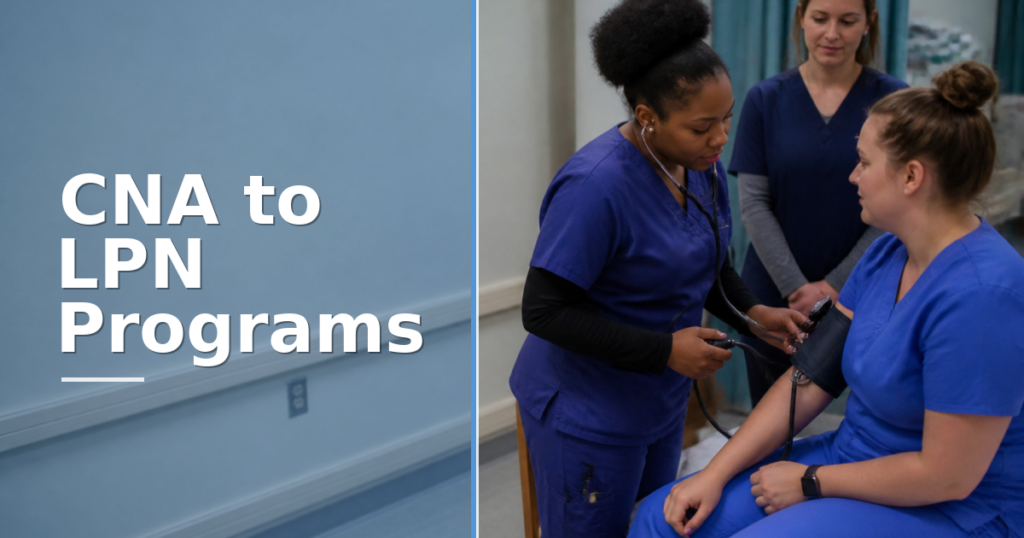
- Vital signs: measuring blood pressure, pulse, respirations, and temperature accurately
- Activities of daily living (ADLs): assisting with bathing, dressing, grooming, feeding, and toileting
- Safe transfers and body mechanics: moving patients from bed to wheelchair and back without injury
- Infection control: proper hand hygiene, gloving, gowning, and handling of soiled linens
These are the same skills you will demonstrate again on your state competency exam, so treat every clinical shift as exam prep.
Realistic Time Commitment
How quickly you finish depends on the schedule you choose. Full-time programs, which typically meet five days a week, wrap up in roughly four to eight weeks. Part-time or evening and weekend tracks stretch that timeline to about 12 to 16 weeks. Either way, clinical hours are completed on-site; no state allows you to fulfill them virtually. Plan your work and family schedule around that requirement before you enroll.
Your CNA Certification Timeline at a Glance
From your first eligibility check to appearing on your state's nurse aide registry, the entire CNA certification process typically takes 4 to 12 weeks. The timeline depends on your state's required training hours and how quickly you schedule your competency exam. Here is the sequence most candidates follow.

Step 3: Pass the State CNA Competency Exam
The CNA competency exam is a two-part gatekeeper: one part tests what you know, and the other tests what you can safely do in front of an evaluator. This is where your classroom knowledge and clinical practice are verified, not where you learn something new. You must pass both parts to be placed on your state's nurse aide registry.
Two parts, one test day
Most states use a written or oral knowledge test with 60 to 100 multiple-choice questions, and passing scores generally sit between 70 and 80 percent. The hands-on skills demonstration usually asks you to perform three to five skills randomly selected from a larger pool. Every critical step counts, especially infection-control actions such as hand hygiene.
Major testing vendors you may register with
Three testing companies show up most often. Credentia administers the NNAAP exam, with a standard 70-item written test in 90 minutes and five skills drawn from 23. Prometric commonly uses a 60-question written test at 90 minutes and five skills timed around 31 to 40 minutes, with handwashing and indirect care often built in. D&S/Headmaster programs typically assign five skills in about 30 minutes. Exact counts, time limits, and skill pools vary by state, so check your state's candidate handbook before registering.
Retake rules are state-specific
No single retake policy applies everywhere, but a few patterns hold. Most states give you multiple attempts within a 24-month window, then require new training if you exhaust them. Arizona allows unlimited attempts within two years, with a 45-day wait after a third failed knowledge attempt only. Minnesota caps knowledge attempts at four and skills attempts at three in 24 months. Maryland allows four total attempts and requires new training after four failures. Expect a separate retake fee per attempt.
Why first attempts fall short
- Rushed steps: Moving too quickly causes candidates to skip a required sequence or forget to explain what they are doing.
- Missed infection control: Forgetting hand hygiene, glove changes, or other safety checkpoints is a common automatic failure.
- Test-day anxiety: Freezing or losing order under evaluator observation is common, so rehearse skills aloud on a mock run.
Before you schedule, confirm your state's specific vendor and retake policy. A calm, methodical approach to both sections is your best preparation.
What Certified Nursing Assistants Actually Earn, State by State
CNA pay varies significantly depending on where you work. The top-paying states for nursing assistants currently offer median wages above $49,000, while even the lowest-paying states on this list land above $42,000. With the Bureau of Labor Statistics projecting 3% job growth for nursing assistants and orderlies from 2025 to 2035 and roughly 203,300 openings expected each year, steady demand continues to put upward pressure on wages. Note that these figures reflect nursing assistant occupations broadly, are based on the most recently published federal wage data, and may not capture every 2026 adjustment.
| State | Total Employed | Median Annual Wage | 25th Percentile Wage | 75th Percentile Wage |
|---|---|---|---|---|
| Oregon | 14,800 | $49,830 | $47,480 | $59,080 |
| Washington | 30,270 | $49,180 | $46,980 | $57,930 |
| New York | 87,990 | $48,590 | $43,760 | $51,980 |
| New Hampshire | 7,810 | $47,870 | $44,890 | $54,400 |
| District of Columbia | 3,490 | $47,700 | $42,400 | $51,850 |
| California | 110,060 | $47,630 | $45,850 | $54,800 |
| Colorado | 22,240 | $47,380 | $44,550 | $49,920 |
| Vermont | 3,030 | $47,130 | $40,850 | $48,940 |
| Maine | 8,540 | $47,070 | $44,200 | $50,190 |
| New Jersey | 32,400 | $46,830 | $43,950 | $48,760 |
| Minnesota | 29,120 | $46,680 | $40,340 | $49,330 |
| Massachusetts | 38,130 | $46,680 | $44,340 | $49,800 |
| Rhode Island | 10,220 | $46,440 | $44,760 | $47,460 |
| Alaska | 2,060 | $46,370 | $45,120 | $52,240 |
| Illinois | 68,640 | $45,960 | $39,420 | $48,380 |
| North Dakota | 6,840 | $45,820 | $36,410 | $47,950 |
| Nevada | 8,100 | $45,490 | $39,100 | $47,990 |
| Hawaii | 5,050 | $45,350 | $40,060 | $50,440 |
| Wisconsin | 28,370 | $45,130 | $39,580 | $47,320 |
| Connecticut | 21,380 | $44,790 | $41,900 | $47,180 |
| Arizona | 20,320 | $44,780 | $38,320 | $46,630 |
| Pennsylvania | 67,740 | $44,590 | $39,270 | $46,850 |
| Maryland | 27,720 | $43,240 | $38,400 | $45,760 |
| Virginia | 40,580 | $43,200 | $37,020 | $46,930 |
| Delaware | 5,530 | $42,030 | $38,490 | $45,210 |
From CNA to LPN: Mapping Your Bridge Program Timeline
An LPN license lets you do things a CNA cannot legally touch: administer oral and injectable medications, perform sterile wound care and dressing changes, insert catheters, monitor IV lines, and take on delegated tasks like tracking vital signs trends for a care plan rather than just reporting a number. That expanded scope is why so many working CNAs eventually look at CNA to LPN Programs instead of starting LPN school from zero.
What the Timeline Actually Looks Like
A true CNA-to-LPN bridge, built specifically for certified aides, typically runs 9 to 12 months full-time. A standard LPN program that simply accepts CNAs alongside other applicants usually takes 12 to 18 months, since it isn't structured to shorten anything for you. Going part-time while you keep working stretches either path to roughly 18 to 24 months. The gap between these numbers comes down to whether the school has built genuine credit transfer into its curriculum or is just admitting you with the same requirements as everyone else.
Prerequisites Worth Confirming Before You Apply
- Work history: Many bridge programs want 6 to 12 months of CNA experience, or somewhere in the 500 to 1,000 hour range, along with an active certification.
- Academic prep: Expect a high school diploma or GED, a GPA around 2.5, and coursework in anatomy and physiology, basic algebra, English composition, and medical terminology.
- Entrance testing: The TEAS exam is common at selective programs, though not universal.
- Standard checks: Background screening, drug testing, updated immunizations, and current CPR/BLS certification.
Credit for Prior Learning Isn't Guaranteed
Some schools grant advanced standing for CNA coursework or work experience, trimming 2 to 4 months off the program. Others treat your CNA background as helpful preparation but don't formally shorten anything. This varies by school and state, so ask directly during LPN/LVN Program Admissions rather than assuming.
Because employers, especially in long-term care, lose money every time a CNA leaves for school, many offer tuition assistance or reimbursement for staff advancing to LPN. Ask your DON before you enroll anywhere.