

A Licensed Practical Nurse, called a Licensed Vocational Nurse in California and Texas, is a state-credentialed clinician who provides direct patient care under the supervision of a registered nurse or physician , a Licensed Practical Nurse vs Registered Nurse distinction that shapes the role. The title differs by state, but the role is functionally identical: medication administration, wound care, vital signs monitoring, and patient documentation across hospitals, nursing homes, clinics, and home health agencies.
State-by-state scope of practice rules create real variation in what LPNs can legally perform, from IV therapy to supervisory duties, which shapes both daily responsibilities and earning potential. The Bureau of Labor Statistics reports a national median annual LPN/LVN Salary of $64,400 for LPNs, though top-paying states exceed $70,000.
What Is an LPN? Core Job Description
An LPN is a licensed frontline caregiver who delivers hands-on bedside nursing under the direction of an RN or physician, not an unlicensed aide and not an independent practitioner, but a distinct, credentialed member of the care team.
The License Behind the Title
The title itself is a legal designation, not just a job description. To use it, a nurse must complete a state-approved LPN school program, typically 12 to 18 months, covering anatomy, pharmacology, nutrition, and supervised clinical rotations. Graduates then sit for the NCLEX-PN, the national licensing exam that verifies competency in safe, entry-level nursing practice. Passing it grants a state license (called LVN in Texas and California), which must be renewed through continuing education. Everything an LPN does on the job flows from that license and the scope of practice it defines.
Bedside Care, Not Independent Practice
Day to day, that means checking vital signs, administering medications, dressing wounds, inserting catheters, and documenting patient conditions. It also means being the nurse patients see most often, since LPNs typically spend more direct time at the bedside than RNs, who juggle broader clinical oversight and administrative duties. LPNs assess and report, but the RN or physician makes the diagnostic and treatment-planning calls. That supervisory relationship is not a limitation so much as the defining structure of the role: LPNs are trusted with real clinical judgment within clearly bounded tasks.
A Role That Shows Up Everywhere
Hospitals employ LPNs, but they are far from the only setting. Nursing homes and long-term care facilities rely heavily on LPNs for daily resident care. Home health agencies place them in patients' homes for wound care and chronic disease management. Physician offices and clinics use LPNs for intake, injections, and patient education. Correctional facilities, school nurse roles, and LPNs in Hospice Care round out the list. That range is part of what makes the job description harder to pin down in a single sentence, and why the duties and scope-of-practice breakdowns that follow matter so much for anyone deciding where this career could take them.
Daily Duties and Responsibilities of an LPN
Licensed practical nurses handle a broad range of clinical and administrative tasks every shift. The specifics vary by employer and state scope of practice, but the core duty categories below appear across virtually every LPN job description in 2026. Understanding these responsibilities helps prospective students gauge whether the role fits their strengths.
| Duty Category | Example Tasks | Notes |
|---|---|---|
| Patient Assessment and Vital Signs | Measuring blood pressure, pulse, temperature, respirations, and oxygen saturation; observing changes in patient condition; reporting findings to the supervising RN or physician | LPNs collect and document data but typically do not formulate nursing diagnoses, which remain within the RN scope |
| Medication Administration | Administering oral, topical, subcutaneous, and intramuscular medications; monitoring for side effects; documenting doses in the electronic health record | IV medication privileges vary by state. Some states allow LPNs to administer IV meds after additional training and certification, while others restrict this to RNs |
| Wound Care and Dressing Changes | Cleaning and irrigating wounds, applying sterile dressings, monitoring healing progress, and documenting wound characteristics | Common in long term care, home health, and post surgical settings |
| Basic Bedside Nursing Care | Assisting with bathing, feeding, ambulation, positioning, and catheter care; ensuring patient comfort and safety | These hands on duties make up a large share of daily LPN work, especially in nursing homes and rehabilitation facilities |
| Patient and Family Education | Teaching patients about medications, post discharge care, diet modifications, and chronic disease management | LPNs reinforce care plans developed by RNs or physicians; the depth of teaching responsibility may expand with experience |
| Documentation and Charting | Recording assessments, interventions, and patient responses in electronic health records; updating care plans as directed | Accurate, timely documentation is a legal and regulatory requirement across all practice settings |
| Communication and Care Coordination | Reporting status changes to supervising RNs and physicians; participating in shift handoff reports; coordinating with therapists, social workers, and dietary staff | Strong communication skills help LPNs serve as a critical link between the care team and the patient |
| Specimen Collection and Point of Care Testing | Collecting blood, urine, and other specimens; performing fingerstick glucose checks and rapid diagnostic tests | Phlebotomy duties depend on facility policy and state regulations; some employers require a separate phlebotomy certification |
LPN Scope of Practice: What LPNs Can and Cannot Do
Scope of practice is the legal boundary that defines which clinical tasks you can perform as an LPN or LVN. These boundaries are not set nationally: the CNA vs LPN vs RN scope of practice varies by state, and each state's board of nursing writes its own nurse practice act. That means a task you performed routinely in one state may be prohibited or require additional certification in another.
Tasks Commonly Restricted for LPNs
Across most states, LPNs work under the direction of a registered nurse, advanced practice provider, or physician. This supervised model means certain responsibilities are typically off-limits:
- Initial nursing assessments: LPNs collect patient data, but the formal initial assessment that establishes the baseline for care is reserved for RNs.
- Developing or modifying care plans: LPNs contribute observations and reinforce teaching, yet the independent creation or revision of a nursing care plan falls outside LPN scope.
- IV push medications: The answer to Can LPNs Administer Medication? varies by state: most states either prohibit LPNs from administering IV push drugs entirely or permit it only after completing an approved validation course, and even then with significant restrictions.
- Medical diagnosis or independent prescribing: These remain firmly in the domain of physicians, APRNs, and PAs.
How Four States Handle IV Push Differently
IV push rules illustrate just how much variation exists:
- New York: LPNs may prepare and administer IV medications through a peripheral line, but IV push is categorically banned except for saline or heparin flushes. First doses of any IV drug, antineoplastic agents, and antibody therapies are also prohibited.
- Ohio: IV push is prohibited for LPNs, with only heparin or saline flushes of intermittent infusion devices allowed.
- Texas: IV push is not an entry-level skill. LVNs must complete a board-approved validation course before administering IV push medications. Even then, PICC and midline insertion or removal remains beyond LVN scope.
- Tennessee: LPNs may deliver selected IV push medications, but only on peripheral lines, only for adult patients weighing more than 80 pounds, and only after completing approved training. Pediatric and prenatal obstetrical patients are excluded entirely.
Verify Before You Practice
Before assuming any task is within your scope, look up your state board of nursing's current practice act. Rules change, and facilities sometimes add their own policies on top of state regulations. When you relocate or pick up per diem shifts across state lines, rechecking scope protects both your license and your patients.
LPN Job Description by Work Setting
Where you work as an LPN shapes everything from your daily task list to your schedule, pace, and paycheck. The table below breaks down four of the most common settings, which together account for roughly 77 percent of all LPN employment, plus one of the highest paying niches. Use it to weigh which environment fits your clinical interests and lifestyle.
| Setting | Share of LPN Jobs | Core Duties | Pace and Environment | What Makes It Different | Median Annual Pay (2024) |
|---|---|---|---|---|---|
| Nursing and Residential Care Facilities | About 37% | Bedside care including vital signs, medication administration, injections, wound care, assisting with eating and bathing, documenting and reporting residents' conditions to supervising RNs and physicians | Structured and routine focused. LPNs coordinate activities of daily living and delegate tasks such as bathing and vital sign collection to CNAs. Shifts often include evenings and weekends. | Long term relationships with residents set this apart. You follow the same individuals over months or years, tracking subtle changes in condition and coordinating with social services, making it ideal for nurses who value continuity of care. | $64,170 |
| Hospitals (State, Local, and Private) | About 16% | Collecting lab samples, inserting catheters, taking vital signs, administering oral and (with certification) some IV medications, wound care, and delegating tasks to CNAs under close RN supervision | Fast paced and acute. Patient conditions can change quickly, and LPNs must respond in real time. RNs handle initial assessments and certain IV therapies, so teamwork is constant. | Exposure to complex, short term cases and a wider range of clinical procedures, but with clear practice boundaries. LPNs cannot perform initial patient assessments and may need additional IV certification. Best for nurses who thrive under pressure. | $59,200 |
| Home Health Services | About 12% | Evaluating patient condition in the home, wound cleaning and dressing, medication administration, assisting with personal hygiene, accompanying patients on outings, and educating families on wound management | Mobile and relatively autonomous. LPNs travel between multiple patient homes throughout the day. If IV certified, they may administer certain IV medications. The pace varies by caseload. | You practice with more independence than in a facility, and you collaborate closely with family caregivers. Patient and family education is a bigger part of the role, and emotional support, including conversation to promote mental well being, is expected. | $61,300 |
| Physician Offices and Clinics | About 12% | Recording medical histories, taking vital signs, administering injections, collecting lab specimens, observing patient response to treatment, preparing patients for provider exams, and coordinating results | Predictable, largely daytime, outpatient workflow. Tasks follow a scheduled appointment rhythm, and most complex assessments are reserved for physicians and RNs. | Regular weekday hours and ongoing relationships with ambulatory patients appeal to nurses who want work life balance. The role blends clinical tasks with patient education in a lower acuity environment. | Average annual salary around $51,210 (exact BLS median not separately reported) |
| Outpatient Care Centers | Smaller share (not separately reported) | Similar outpatient clinical tasks including vital signs, medication administration, wound care, specimen collection, and patient education, often in specialty or surgical centers | Scheduled outpatient flow with potential for higher acuity procedures than a typical physician office, depending on the specialty focus of the center | This setting posts the highest reported median LPN pay among all work environments, making it worth pursuing for nurses who want top earning potential in an ambulatory role. | $69,630 |
Related Articles
A Day in the Life: What Does an LPN Do on a Daily Basis?
The biggest day-to-day variable in working as a licensed practical nurse is not the task list but the setting. Core duties like medication administration, documentation, and patient communication look similar on paper, yet, for an LPN in the inpatient vs. outpatient setting, the rhythm of a shift changes sharply from a nursing home floor to a hospital unit to a home health route.
Nursing home: a structured rhythm around med passes
A typical day shift starts with report from the overnight nurse and a quick scan of the medication administration record. From there, the morning is built around medication passes, vital signs, and helping residents with breakfast and morning care. You will pause for wound care or a blood sugar check in between. Documentation often happens in short bursts at the nurses' station, between resident calls. Family members may phone in for updates, and you may step in to explain a new order or a change in condition before the afternoon med pass repeats the cycle. The shift ends with another report, a final round of charting, and a handoff to the evening nurse.
Hospital floor: faster pace, closer supervision
On a hospital floor, the day starts with shift huddle and bedside report. You may be assigned a set of patients alongside an RN, taking vitals, collecting specimens, checking blood sugars, and completing focused assessments. Medication passes still anchor the morning, but interruptions come faster: a call light, a new lab result, a patient preparing for discharge. Documentation may need to happen closer to real time, and you will likely communicate with the RN repeatedly about changes in status. The pace is less predictable, but the chain of command is closer.
Home health: autonomy on the patient's turf
In home health, the day starts with route planning and phone calls to confirm visits. Each stop is its own mini shift. You might check vital signs, set up medications, perform wound care, and teach a caregiver how to help with a dressing change. Between visits, you document in the car and troubleshoot schedule changes. You are often the only nursing professional in the home, so you make more independent observations and then report back to a supervising RN or care coordinator.
Across all three settings, documentation, medication passes, and patient and family communication recur daily. The difference is how much structure and backup surrounds you. In practice, new grads exploring licensed practical nurse careers often start in long-term care, where the structured rhythm helps build confidence before moving to a more autonomous home health role.
The first year, you're focused on getting the basics right: vitals, meds, documentation. A few years in, you're the one other new grads come to when something doesn't look right.
New-Grad Vs. Experienced LPN: How Responsibilities Grow
An LPN's job description on paper stays fairly consistent, but what that job actually looks like shifts a great deal between the first year on the floor and a decade in. The scope of practice set by the state board doesn't change, but the range of tasks an employer entrusts to a given nurse absolutely does.
The New-Grad Starting Point
Most new LPNs begin with closer supervision and a narrower slice of the job description. Facilities typically pair them with a preceptor, assign smaller patient loads, and limit them to core tasks: vitals, medication administration, basic wound care, documentation. This isn't a reflection of limited scope so much as limited speed and confidence. New grads are still building the muscle memory to move efficiently through a shift, and employers know it takes months, not weeks, for that rhythm to click.
How Trust Expands the Role
As LPNs prove reliable and efficient, employers often widen what they're asked to handle. Experienced LPNs frequently take on charge-nurse-adjacent duties on a unit, such as coordinating assignments or acting as the point person for a shift, even though the charge title itself may require RN licensure in some settings. Many precept new hires, passing along the practical judgment that no orientation packet can teach. Others specialize, pursuing Specialty Certification for LPNs in wound care, IV therapy where state rules permit it, or long-term care management.
Certification, Not Redefinition
This growth happens through employer trust and additional credentials, not because the state redefines what an LPN is legally allowed to do. A nurse manager isn't expanding the job description in the legal sense; they're expanding it in the practical sense, assigning more responsibility to someone who has earned it. That distinction matters for anyone mapping out a career, since advancement tends to come from stacking skills and reputation within a workplace or from pursuing LPN to RN Bridge Programs rather than waiting for scope itself to shift.
LPN Vs. RN: How the Job Descriptions Differ
Both Licensed Practical Nurses and Registered Nurses work side by side in hospitals, nursing homes, and clinics, but their education requirements, scope of practice, and day-to-day responsibilities are distinct. The table below breaks down the key task-level differences you will encounter in shared clinical settings, drawing on current state board of nursing rules and professional association guidance.
| Dimension | Licensed Practical Nurse (LPN/LVN) | Registered Nurse (RN) |
|---|---|---|
| Education and licensure path | Certificate or diploma program, typically 12 to 18 months, followed by the NCLEX-PN exam | Associate degree (about 2 years) or Bachelor of Science in Nursing (4 years), followed by the NCLEX-RN exam |
| Patient assessment | Collects objective and subjective patient data and documents findings, but does not independently analyze data, make nursing diagnoses, or determine the nursing care plan | Performs a comprehensive health-status assessment, analyzes the data, makes nursing diagnoses, and develops or revises the nursing care plan |
| Care-plan development and revision | Contributes patient data and implements the established plan within their scope, but does not independently develop or revise nursing care plans | Independently develops, implements, and revises care plans, sets nursing priorities, and determines appropriate interventions |
| IV therapy | After completing required IV-therapy education, may administer IV fluids and medications, adjust flow rates, monitor insertion sites, and discontinue infusions under RN or provider supervision and within state-specific limits. May not perform venipuncture or manage central lines unless specifically authorized by state board rules. | Initiates, manages, and supervises all IV therapy, including venipuncture, IV push medications, and central venous catheter management. Selects appropriate therapies, sets monitoring parameters, and oversees any IV tasks delegated to LPNs. |
| Medication administration | Administers prescribed medications and treatments, including some IV therapies where state law and facility policy permit. May not administer high-risk medications that require independent nursing judgment beyond the LPN scope. | Administers a full range of medications, including high-risk agents. Uses independent nursing judgment to assess indications, monitor effects, and decide when to hold or adjust therapy. |
| Ongoing monitoring and response | Collects and documents ongoing assessment data and reports changes in patient condition to the RN. Does not independently alter the plan of care based on new findings. | Analyzes ongoing assessment data, determines needed nursing interventions, and modifies the care plan in response to changes in patient condition. |
| Delegation authority | Has limited delegation authority. May delegate certain tasks to unlicensed assistive personnel only when specifically directed by an RN, physician, or other authorized provider, and must follow established protocols. | Conducts a nursing assessment before delegating, determines which tasks may safely be assigned to unlicensed personnel, specifies the required level of supervision, and remains accountable for evaluating outcomes. |
| Supervisory relationship | Typically reports to and receives task delegation from an RN, physician, nurse practitioner, or physician assistant. Works within a collaborative framework but does not function as an independent practitioner. | Serves as the clinical lead at the bedside, delegates tasks to LPNs and unlicensed staff, and carries ultimate accountability for the nursing care delivered on their unit or assignment. |
LPN Median Salary at a Glance
Before diving into the detailed state-by-state breakdown below, here is the single number every aspiring LPN should know. This national median reflects what a typical Licensed Practical or Licensed Vocational Nurse earns across all settings, experience levels, and regions.

LPN Job Outlook and Salary Snapshot
The table below highlights the highest-paying states for Licensed Practical and Licensed Vocational Nurses, drawing from 2025 Bureau of Labor Statistics wage estimates. These figures are approximate and reflect the most recent published data rather than real-time compensation. Keep in mind that cost of living, facility type, and local demand all influence what LPNs actually take home. According to BLS projections, LPN/LVN employment is expected to grow roughly 3% from 2025 to 2035, a pace that tracks the average across all occupations. That modest net growth number, however, understates the real opportunity: the Bureau projects approximately 51,800 openings per year over that decade, driven largely by retirements and career transitions rather than brand-new positions. An aging population, rising rates of chronic disease, and expanding healthcare and social assistance needs all sustain steady demand for hands-on bedside care, exactly the work LPNs do every day. For a deeper dive into pay by metro area, experience level, and setting, visit the dedicated LPN salary page on practicalnursing.org.
| State | Total Employment | 25th Percentile Salary | Median Salary | 75th Percentile Salary |
|---|---|---|---|---|
| Washington | 6,780 | $76,920 | $83,150 | $93,970 |
| Alaska | 290 | $70,490 | $80,800 | $87,380 |
| Oregon | 4,260 | $73,040 | $80,470 | $90,690 |
| Massachusetts | 13,210 | $72,610 | $80,220 | $84,570 |
| Rhode Island | 1,290 | $77,890 | $80,090 | $81,170 |
| California | 82,850 | $74,840 | $79,750 | $93,720 |
| New Hampshire | 2,220 | $67,650 | $77,110 | $82,760 |
| Arizona | 6,530 | $66,770 | $77,070 | $81,860 |
| Nevada | 3,350 | $65,930 | $76,160 | $79,570 |
| District of Columbia | 1,040 | $63,960 | $75,740 | $81,400 |
| New Jersey | 17,410 | $66,890 | $75,160 | $79,980 |
| Illinois | 17,440 | $63,580 | $75,000 | $79,560 |
| Maryland | 9,560 | $65,300 | $74,660 | $79,670 |
| Colorado | 4,920 | $61,890 | $73,880 | $79,800 |
| Connecticut | 8,540 | $66,660 | $73,690 | $76,830 |
Steady nationwide demand paired with wide state-by-state pay differences means where you work matters as much as the credential itself. Job seekers who compare local wages, setting, and shift differentials will find real leverage in a market that is not slowing down.
Skills and Traits That Make a Strong LPN
A strong LPN blends hands-on clinical competence with the kind of interpersonal steadiness that keeps a shift running smoothly. Programs test the clinical half; employers screen hard for the rest during interviews and orientation.
Clinical Skills That Get Checked First
Hiring managers look for accuracy under pressure more than speed. That means correct medication administration (right dose, right route, right documentation), reliable vital signs monitoring across a full patient load, and comfort with basic wound care, dressing changes, and recognizing when a wound looks wrong. These are the skills a nursing program drills repeatedly because a single error in any of them can cascade into a real patient safety issue.
Soft Skills Employers Actually Screen For
- Communication: Relaying changes in patient condition clearly to an RN or physician, and explaining care in plain language to patients and families.
- Time management under interruption: LPNs rarely finish one task before the next emergency starts. Prioritizing on the fly is a daily requirement, not an occasional stretch.
- Empathy: Especially in long-term and home settings, patients need reassurance as much as treatment.
- Physical stamina: Long shifts on your feet, lifting, and repositioning patients take a toll without conditioning.
Why the Mix Shifts by Setting
For LPNs in community health settings, home health rewards independent judgment since there's no charge nurse down the hall to double-check a decision. Hospital floors reward fast triage instincts and composure when several patients decline at once. Nursing homes lean on relationship-building since LPNs there often know residents for years.
A Quick Self-Check Before Enrolling
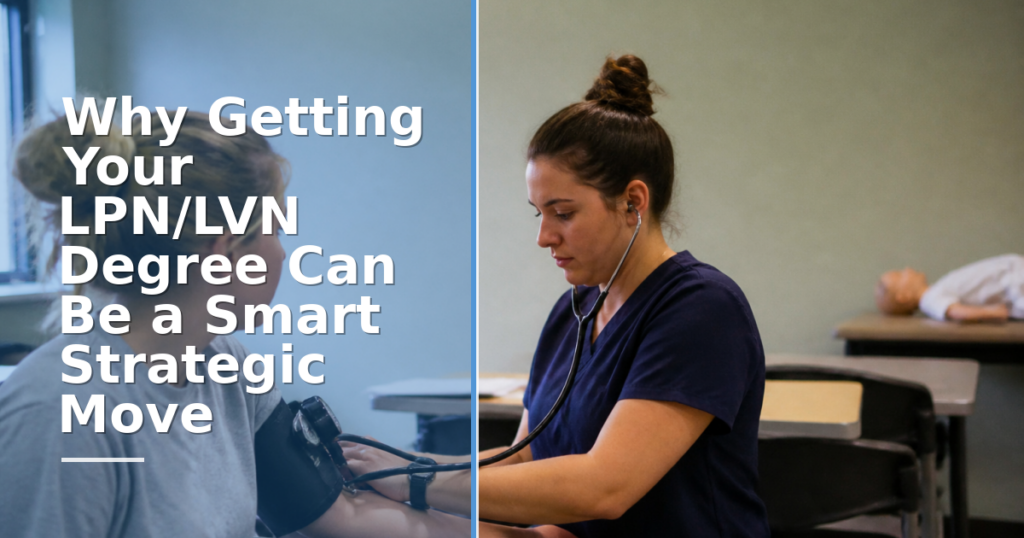
Ask honestly: Do you stay calm when three things go wrong at once? Can you follow a precise protocol without skipping steps, even when rushed? Do you find satisfaction in repetitive, detail-heavy tasks like charting and medication passes? If the answers lean yes, the clinical and emotional demands of LPN work are likely a fit worth pursuing, and getting your LPN/LVN degree can be a smart strategic move.