

How many approved LVN programs actually exist within San Francisco city limits? Just one: City College of San Francisco's vocational nursing certificate. That scarcity shapes everything for aspiring practical nurses in the Bay Area, from waitlist timelines to commute decisions.
The job market, at least, is not the bottleneck. Kaiser Permanente, UCSF Health, Sutter Health, and dozens of skilled nursing facilities and community clinics across the metro actively hire LVNs, with a median LPN/LVN salary well above the state average. Demand is strong; supply of training seats is tight.
CCSF's requirements, nearby-program tuition at LVN programs in San Jose, Oakland, and the Peninsula, and NCLEX-PN pass rates are the real numbers you can use to weigh your options. Jump straight to the program list →
The San Francisco LVN Job Market: Who's Hiring and Why It Matters
Choosing between a community college program with lower tuition or a private vocational school with faster completion becomes easier once you understand where the LPN & LVN jobs actually are and what they pay.
Major Healthcare Employers in the Bay Area
San Francisco and the surrounding region host some of California's largest health systems, all of which employ LVNs across multiple care settings:
- UCSF Medical Center: Hires LVNs for outpatient specialty clinics, procedural support, and ambulatory care.
- Kaiser Permanente: Staffs LVNs in primary care clinics, urgent care, and some inpatient med-surg units across its Northern California network.
- Sutter Health: Employs LVNs in long-term care, skilled nursing facilities, and clinic-based roles throughout the Bay Area.
- Dignity Health / CommonSpirit: Fills LVN positions in acute rehabilitation, wound care, and community health centers.
- San Francisco VA Medical Center: Hires LVNs for primary care, mental health, and long-term care serving veterans.
Scope of Practice Advantage
California grants LVNs one of the broader scopes of practice in the country. With proper certification, LVNs here can start and maintain IV therapy, administer a wide range of medications, perform wound care, and assist in procedures under RN or physician supervision. This expanded scope translates to more hiring opportunities and higher earning potential compared to states with restrictive LVN duties.
Regional Demand Beyond San Francisco
LVN job openings extend well beyond the city limits. San Jose, Oakland, Daly City, Fremont, and Hayward all have strong healthcare sectors and active LVN hiring. Many Best LVN Programs in California draw students from across these metros, and clinical rotations often place students at facilities throughout the region.
Why Cost and Value Matter More Here
San Francisco's cost of living ranks among the highest in the nation. That reality makes tuition affordability and post-graduation earning potential critical factors when evaluating the Most Affordable LPN/LVN Programs. A $20,000 difference in tuition can take years to recover, even with competitive Bay Area wages.
CCSF LVN Program: Requirements, Waitlist, and Cost
City College of San Francisco offers one of the few publicly funded LVN programs in the Bay Area, making it a go-to option for students seeking affordable vocational nursing education. The program awards a Certificate in Vocational Nursing after 40.5 units of coursework spread across three semesters, with an 18-month timeline from start to finish.1
Admission Prerequisites
CCSF's LVN program requires prospective students to complete prerequisite courses before applying: anatomy and physiology, pharmacology, nutrition, and child growth and development, all completed within five years prior to enrollment.2 Applicants must also submit TEAS exam scores; published minimums include a 2.5 science GPA and a 2.0 in English 1A, while the 2025-2026 TEAS cutoff is not stated in current online materials. The college holds a mandatory orientation session for applicants seeking Spring 2026 admission, delivered via Zoom with no advance registration required.2 Contacting the Licensed Vocational Nursing Department directly is the most reliable way to confirm exact prerequisites and application deadlines.
Application Cycle and Cohort Timeline
The program admits one cohort annually, with application windows opening several months before the start term. Whether a formal waitlist exists for the 2025-2026 cycle is not confirmed in published program materials, but community college nursing programs in the Bay Area commonly maintain waitlists due to limited clinical placement slots. Prospective students should attend the mandatory orientation early in the cycle to understand current wait times and selection criteria.
Tuition and Financial Aid
As a California community college, CCSF charges California residents $46 per unit in enrollment fees.3 For a 40.5-unit program, that translates to roughly $1,863 in tuition alone, plus additional costs for books, supplies, uniforms, and health clearances. Non-resident students face significantly higher charges, with per-unit costs ranging from $400 to $406 depending on fee category, pushing total tuition above $16,000 before supplies.3
California residents who have lived in the state for at least 366 consecutive days before the semester begins qualify for in-state rates.4 Many students offset costs further through the California College Promise Grant (formerly BOG fee waiver), which can cover enrollment fees entirely for eligible low-income applicants. San Francisco's Office of Economic and Workforce Development funds entry-level allied health training such as CNA and medical assistant, not LVN in current listings; qualifying CCSF students can reduce or eliminate enrollment fees through the California College Promise Grant and Free City.
Clinical rotations take place at local hospitals and skilled nursing facilities throughout San Francisco, giving students hands-on experience in the city's healthcare system.
How Much Do LVN Programs Cost in San Francisco?
Cost, not curriculum, has become the deciding factor for many Bay Area LVN applicants in 2026. The spread is wide: public in-state sticker prices in this list run from about $1,156 to $1,696 per year, while the private programs trend toward $32,000 to $39,000 after aid, and some California private LVN schools exceed $50,000 before scholarships.
Sticker Price vs. Net Price
Look past the headline tuition number. Sticker price is what the school charges before grants and waivers. Net price is what students actually pay after need-based and institutional aid, and it is the fairer comparison. For example, City College of San Francisco, one of the Community College Nursing Programs, carries a low in-state tuition but an estimated net price near $6,906. Los Medanos College runs about $7,443, Napa Valley College around $14,644. The private schools land higher: Gurnick Academy around $32,427 and Carrington College Pleasant Hill around $39,357.
Free or Near-Free Routes
- California College Promise Grant: Can waive enrollment fees for eligible California residents. Apply or reapply each year via FAFSA or CADAA; one need threshold is $1,104 or more demonstrated need.
- Pell and Cal Grant: Public community college LVN programs are generally Title IV eligible, so these grants can cover much of the remaining cost. The Vocational Nurse Scholarship Program offers up to $4,000 for a 12-month service commitment in an underserved area.
- Free City: San Francisco residents may qualify for fee-free CCSF enrollment, but verify unit caps and how aid stacks with other grants.
- OEWD and employer sponsors: San Francisco's OEWD Healthcare Academy funds entry-level allied health training such as CNA and medical assistant, not LVN in current listings. No widely advertised Kaiser, Sutter, or Dignity Health LVN tuition pipelines surfaced in 2026 Bay Area sources, so ask for a written service commitment before relying on one.
Add These Costs to Tuition
Tuition is only the starting point. Budget separately for textbooks, uniforms, stethoscope, background checks, immunizations, liability insurance, and NCLEX-PN exam fees related to California LVN Licensure and Challenging the Boards. These items are generally not covered by Promise Grant and often run several hundred to a couple thousand dollars beyond published tuition. At CCSF, for instance, the estimated full program cost near $7,000 reflects tuition plus these extras, not a single-class fee.
LVN Program Tuition at a Glance
Community colleges remain the most affordable path to an LVN certificate in the Bay Area, with published tuition often a fraction of what private vocational schools charge. Financial aid, Pell Grants, and institutional scholarships can narrow the gap even further, so be sure to compare net price after aid, not just sticker cost.

NCLEX-PN Pass Rates for Bay Area LVN Programs
Licensing exam results cut through promotional language and show how well a program actually prepares students for the NCLEX-PN. California's Board of Vocational Nursing and Psychiatric Technicians (BVNPT) tracks these numbers, and the latest published report covers results from 2025. Instead of relying on school marketing alone, you can compare these state-reported outcomes across nearby LVN programs, including LVN programs in San Jose.
What a good pass rate looks like
The BVNPT uses a first-time pass rate below 60% as a probationary trigger. That threshold is not a goal; it is a warning line. Programs that hover near 60% or below may face conditional approval or probation, which can affect your ability to sit for the exam if issues are not corrected. Strong LVN programs in the Bay Area typically show rates in the high 80s or low 90s.
Verifiable 2025 Bay Area results
For the most recent reporting year, two Bay Area programs have clear published numbers:
- City College of San Francisco: 94% first-time NCLEX-PN pass rate in 2025, not on probation.
- Gurnick Academy of Medical Arts, San Jose: 89% first-time NCLEX-PN pass rate in 2025, not on probation.
No probationary status was shown for either school in the BVNPT report. If a full Bay Area list is not visible in the most recent public data, that gap is normal: some programs may have small cohorts or delayed reporting, and newer results appear each year.
Why first-time rates matter for your decision
A high first-time pass rate signals that students master both the clinical content and the test format before graduation. Lower rates can mean more repeats, more exam fees, and a longer wait before you can work as an LVN or pursue LVN to RN in California. Even a small difference of five or ten points can reflect real gaps in teaching, clinical placement quality, or student support. When comparing schools, treat first-time pass rates alongside tuition, clinical hours, and instructor support.
Admissions Requirements and Entrance Exams
Bay Area LVN programs share a core set of admissions requirements, though specific details vary by school. Gather these items early, some, like immunization records and background checks, can take weeks to process. Competitive programs typically require a cumulative GPA of 2.5 to 3.0, so strong prerequisite grades matter.
- High School Diploma or GEDEvery accredited LVN program in the San Francisco area requires proof of high school completion or an equivalent credential before you can apply.
- Prerequisite CourseworkMost programs require completion of anatomy, physiology, English composition, and introductory math. Some also ask for a nutrition or introductory psychology course. Check each school's catalog, missing even one prerequisite can delay your application by a full cycle.
- Entrance Exam (TEAS or HESI)An admissions entrance exam is standard. City College of San Francisco and several other public programs require the ATI TEAS, while some private vocational schools accept the HESI A2 instead. A few programs accept either, so confirm the requirement before you register and pay for a test.
- Background Check and Drug ScreeningA clear criminal background check is required for clinical placement. Most programs also mandate a drug screening. Results with certain convictions or positive screens can disqualify applicants from clinical rotations and, by extension, from the program.
- Physical ExaminationA current physical exam, typically completed within the six months before enrollment, verifies you can meet the physical demands of clinical training, including standing for extended periods and lifting patients.
- CPR CertificationYou will need a current Basic Life Support (BLS) for Healthcare Providers card, usually through the American Heart Association. Online-only CPR courses generally are not accepted; look for a blended or in-person class.
- Immunization Records and TB ScreeningPrograms require up-to-date immunizations including MMR, varicella, hepatitis B, and a current TB screening (either a two-step skin test or a blood test). Clinical facilities will not allow students on-site without verified records.
Related Articles
Ranked LVN Schools Near San Francisco
Below are the top LVN programs serving San Francisco students, ranked by completion data, accreditation status, and program fit. The list covers one campus inside the city and four more within commuting distance across the Bay Area.
How we ranked these
- Median graduate debt
- Institution-wide graduation rates
- Accreditation and state approval
- Net price and total cost
- Access from San Francisco
- College Scorecard graduate earnings — collegescorecard.ed.gov
- Internal program database
- Independent editorial research
- IPEDS institutional survey data from NCES covering graduation rates, retention rates and student-faculty ratios — nces.ed.gov
- Bureau of Economic Analysis cost-of-living index by state — bea.gov

City College of San Francisco
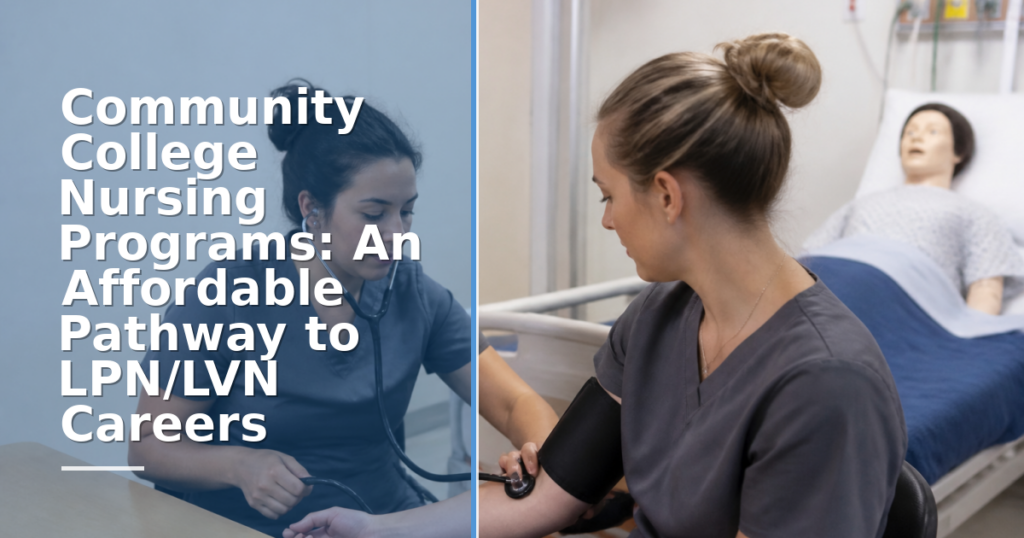
City College of San Francisco is the only ranked program located inside the city, which makes it the natural first stop for San Francisco residents. Institution-wide, the college reports a graduation rate near 40 percent and a net price of about $6,900 a year, with median graduate debt around $8,200. The 18-month certificate is offered on campus and, per the program, also online through CityOnline, and CCSF runs an advanced placement route into its registered nursing program for licensed LVNs. Median earnings ten years after entry are about $45,800 institution-wide; earnings specific to the LVN certificate are not published.
- 18-month, full-time certificate across three semesters
- Carries 40.5 units of college credit
- Approved by the California Board of Vocational Nursing and Psychiatric Technicians
- Clinical training in acute care, clinics, long-term care, and home health
- Coursework spans medical-surgical, mental health, maternity, and pediatric nursing
- Also offered online through CityOnline
- Career assessment and counseling services available
Licensed Vocational Nursing (LVN) Certificate — On-Campus

Napa Valley College
Napa Valley College is a public community college roughly an hour north of San Francisco, so it suits North Bay readers or anyone willing to drive for a part-time schedule. Institution-wide, the college reports a graduation rate near 43 percent, an average net price of about $14,600, and median graduate debt around $10,100. Its vocational nursing certificate takes two years part time, with cohorts averaging about 15 students, and the college reports strong licensure and job placement results plus a bridge pathway to the RN credential. Median earnings ten years after entry are about $49,500 institution-wide; program-level earnings are not reported.
- Part-time, two-year certificate built around working students
- Cohorts average about 15 students
- Program reports a 93% licensure pass rate
- Program reports a 100% job placement rate
- Prerequisite courses required before entry
- Prepares graduates for the NCLEX-VN exam
- VN-to-ADN bridge option to become a registered nurse
- BVNPT-approved program
Vocational Nursing (VN) Certificate — On-Campus

Gurnick Academy of Medical Arts
Gurnick Academy of Medical Arts is a private institution whose vocational nurse diploma is taught at its San Jose campus, roughly an hour south of San Francisco by car or Caltrain. Institution-wide, the college reports a graduation rate near 64 percent, an average net price of about $32,400, and median graduate debt around $17,300. The diploma blends nursing with behavioral and physical sciences and places students in supervised clinical settings, and the academy notes financial aid and military benefits for eligible students. Median earnings ten years after entry are about $66,800 institution-wide; program-level earnings are not reported.
- Diploma blends nursing with behavioral and physical sciences
- Campus-based clinical training in San Jose and four other California cities
- Financial aid available for eligible students
- Military education benefits accepted
- Prepares students to work under physicians and registered nurses
- Graduates work in hospitals, clinics, and long-term care facilities
Vocational Nurse Diploma — On-Campus

Los Medanos College
Los Medanos College is a public community college in Pittsburg, in the East Bay, about an hour from San Francisco by BART and connecting local transit. Institution-wide, the college reports a graduation rate near 41 percent and a net price of about $7,400 a year, and median graduate debt is not reported for the institution. Its three-semester vocational nursing program is campus based, pairs theory with clinical experience, and covers care for clients of all ages under the direction of registered nurses and physicians. Median earnings ten years after entry are about $42,500 institution-wide; program-level earnings are not reported.
- Three-semester, campus-based program
- Theory paired with correlated clinical experience
- Covers care for clients across all age groups
- Meets California Board of Vocational Nurse guidelines
- Graduates practice under registered nurse or physician direction
- Prepares students for LVN licensure
Vocational Nursing (VN) Certificate — On-Campus
Carrington College-Pleasant Hill Campus
Carrington College's Pleasant Hill campus is a private institution in Contra Costa County, reachable from San Francisco by car or BART. Institution-wide, the college reports a graduation rate near 59 percent, an average net price of about $39,400, and median graduate debt around $11,500. Its practical nursing certificate can be completed in as few as 12 months, is campus based, and prepares students for the NCLEX-PN, with financial aid, scholarships, and career services available. Median earnings ten years after entry are about $39,600 institution-wide; program-level earnings are not reported.
- Completed in as few as 12 months
- Campus-based with hands-on clinical training
- Prepares students for the NCLEX-PN exam
- Covers medical-surgical, mental health, and pediatric nursing
- Includes anatomy and physiology coursework
- Supervised clinical rotations plus simulation and lab training
- Pathway to Nursing Bridge program
- Financial aid and scholarships for qualified students
Practical Nursing (PN) Certificate — On-Campus
California by City
- Anaheim, CA
- Antioch, CA
- Bakersfield, CA
- Canoga Park, CA
- Chula Vista, CA
- Concord, CA
- Corona, CA
- Downey, CA
- Fremont, CA
- Fresno, CA
- Irvine, CA
- La Puente, CA
- Lancaster, CA
- Livermore, CA
- Long Beach, CA
- Los Angeles, CA
- Moreno Valley, CA
- North Hollywood, CA
- Oakland, CA
- Palmdale, CA
- Palo Alto, CA
- Pasadena, CA
- Pomona, CA
- Rancho Cucamonga, CA
- Richmond, CA
- Riverside, CA
- Sacramento, CA
- San Bernardino, CA
- San Diego, CA
- San Jose, CA
- San Mateo, CA
- Santa Ana, CA
- Santa Monica, CA
- Stockton, CA
- Thousand Oaks, CA
- Torrance, CA
- Vallejo, CA